
7 Signs Your Legacy Systems Are Ready for AI-Driven Modernization
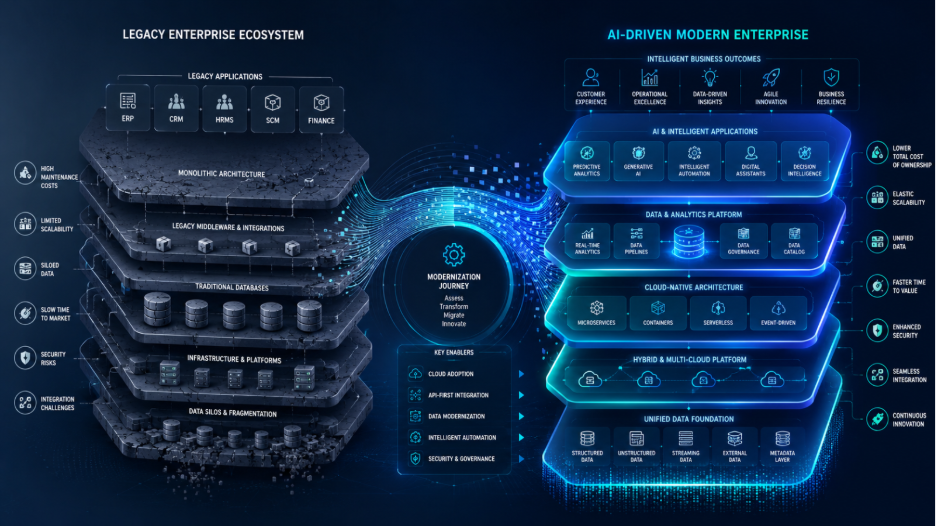
The AI conversation has changed. Most organizations are no longer focused on what AI can do. They’re focused on what it will take to make AI work within the realities of their existing technology environment.
The biggest mistake organizations make when evaluating AI readiness is assuming the journey begins with selecting an AI platform. In reality, AI readiness starts much earlier. It begins with architecture, data, governance, delivery maturity, and the modernization discipline required to connect AI to real business outcomes.
Enterprises that struggle with AI adoption rarely have only an AI problem. More often, they have a modernization problem. Legacy systems may still run critical operations effectively, but if those systems cannot share data, scale securely, integrate with modern platforms, or support rapid delivery, AI initiatives can quickly become expensive experiments instead of enterprise capabilities.
Industry research supports this practical view. McKinsey emphasizes that organizations generating value from AI tend to combine technology deployment with governance, operating model changes, and scalable execution. Gartner also highlights the importance of data readiness, governance, and strategic alignment in enterprise AI adoption.
This is where AI engineering consulting becomes especially valuable. The right AI engineering consulting partner can help assess the current environment, identify modernization gaps, prioritize high-value use cases, and build a practical roadmap for AI implementation.
If your organization is planning AI-driven transformation, here are seven signs your legacy systems may be more ready than you think.
How Do You Know if Legacy Systems Are Ready for AI?
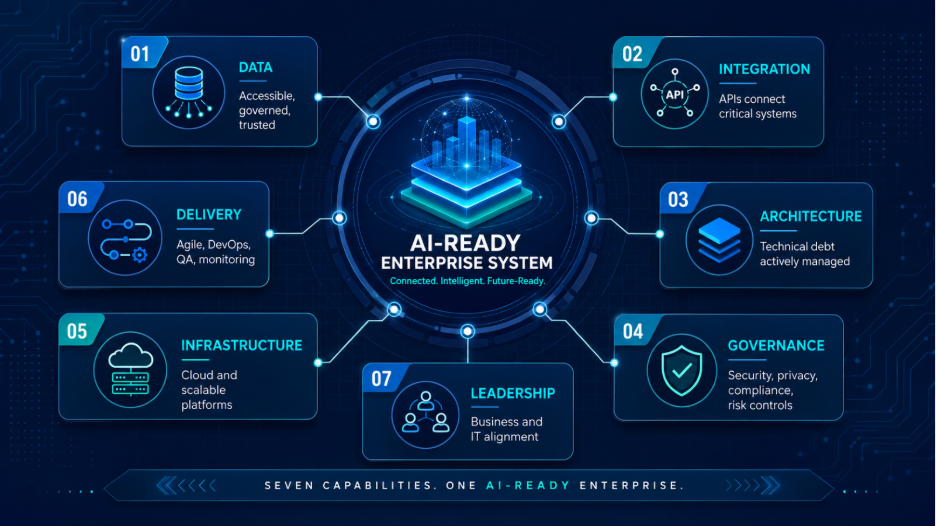
Your legacy systems are likely ready for AI-driven modernization if they demonstrate seven key characteristics:
- Accessible and governed enterprise data
- API-enabled integration capabilities
- Clear visibility into technical debt
- Established governance, compliance, and security controls
- Scalable infrastructure and cloud readiness
- Mature software delivery practices
- Strong alignment between business and IT leaders
Organizations that meet most of these criteria are better positioned to turn AI from isolated pilots into measurable business value. If gaps exist, a structured AI engineering consulting assessment can help determine which modernization priorities should come first.
1. Your Data Is Accessible, Governed, and Usable
AI depends on data. If enterprise information is trapped in disconnected applications, inconsistent databases, or departmental silos, AI initiatives will struggle to generate reliable insights.
A strong sign of AI readiness is that your organization already has meaningful control over its data environment. This may include enterprise data platforms, data warehouses, data lakes, reporting standards, data quality processes, and clear ownership for critical datasets.
Organizations that have addressed data silos and invested in enterprise data analytics are often better positioned to support AI because they have already taken steps toward trusted, accessible information.
What to Look For
- Defined data ownership
- Data quality monitoring
- Enterprise-wide reporting standards
- Secure access to critical datasets
- Consistent data definitions across departments
- Analytics capabilities already in use
For example, consider a financial services organization that has already standardized customer, transaction, and risk data across business units. That organization is far better positioned to apply AI to fraud detection, customer support, or decision intelligence than one still debating which system contains the correct version of the data.
More data does not automatically mean better AI. Better-governed data does.
2. Your Systems Support API-Driven Integration
AI solutions rarely operate in isolation. To create business value, AI must connect with ERP systems, CRM platforms, service management tools, customer applications, data platforms, and operational workflows.
This is why integration maturity is such an important sign of readiness. Organizations that use APIs, middleware, event-driven architecture, or integration platforms are better prepared to connect AI capabilities to the systems where work actually happens.
Effective software modernization often includes API enablement, allowing organizations to modernize around core business systems without immediately replacing every legacy application.
Why Integration Matters
AI solutions may need to:
- Retrieve data from legacy systems
- Trigger automated workflows
- Update customer or operational records
- Deliver recommendations inside existing applications
- Support copilots, agents, and intelligent automation
Imagine a manufacturing company running a long-standing ERP platform. Replacing the ERP system may not be practical in the short term. But exposing inventory, procurement, and production data through APIs can enable AI-powered forecasting, maintenance planning, and supply chain optimization without disrupting core operations.
That is the practical value of integration-led modernization.
3. You Have Visibility Into Technical Debt
Legacy systems are not automatically a problem. Many legacy platforms remain reliable, secure, and deeply embedded in business operations. The real issue is whether the organization understands the constraints those systems create.
AI-ready organizations have visibility into technical debt. They know which applications are difficult to maintain, which integrations are fragile, which platforms are nearing end of support, and which systems create operational risk.
Companies pursuing legacy modernization are often better prepared for AI because modernization efforts force important conversations about architecture, scalability, maintainability, and business value.
Technical Debt Signals to Assess
- Unsupported platforms or operating systems
- Aging programming languages
- Manual deployment processes
- Poor documentation
- Fragile integrations
- Limited scalability
- High maintenance costs
- Security or compliance gaps
A practical question for enterprise leaders is this: Can technology teams clearly explain which systems should be retained, refactored, integrated, migrated, or retired?
If the answer is yes, the organization has already taken a meaningful step toward AI readiness.
4. Governance Is Embedded Into Technology Decisions
AI introduces new risks around data privacy, security, compliance, explainability, accountability, and responsible use. Organizations that wait to address governance until after AI deployment often face delays, rework, and trust issues.
A strong sign of readiness is that governance is already part of enterprise technology decision-making. This may include cybersecurity standards, compliance processes, data stewardship, risk reviews, and executive oversight.
Organizations with mature governance practices can extend existing controls into AI programs rather than building everything from scratch. This is especially important for regulated industries such as healthcare, financial services, insurance, and public sector organizations.
Strong AI governance frameworks and approaches to AI trust and enterprise AI governance help organizations scale AI while maintaining accountability and control.
Governance Capabilities That Support AI
- Data access policies
- Compliance monitoring
- Security reviews
- Risk management processes
- Model oversight practices
- Human-in-the-loop controls
- Clear business ownership for AI use cases
For instance, a healthcare organization with mature privacy, compliance, and data governance practices may be better positioned to explore AI-powered administrative workflows because oversight mechanisms already exist. The governance foundation reduces risk and accelerates responsible adoption.
The organizations creating long-term AI value are not simply moving fast. They are moving fast with control.
5. Your Infrastructure Can Scale with New Workloads
AI workloads can create new infrastructure demands. Some initiatives require real-time data processing. Others require scalable storage, cloud-native services, advanced analytics platforms, or high-performance compute capabilities.
Your legacy environment may be ready for AI if your infrastructure strategy already includes cloud adoption, hybrid cloud architecture, automation, observability, or scalable compute resources.
Successful enterprise technology transformation often includes infrastructure improvements that directly support future AI growth. Organizations that have invested in enterprise infrastructure scalability planning or a structured cloud migration roadmap are often better prepared to support AI beyond the pilot stage.
Infrastructure Readiness Indicators
- Cloud or hybrid cloud adoption
- Scalable compute and storage
- Performance monitoring
- Automated infrastructure management
- Secure network architecture
- Disaster recovery and availability planning
- Cost management practices
Infrastructure readiness does not always mean moving everything to the cloud. It means ensuring the architecture can support AI workloads securely, reliably, and cost-effectively.
Without scalable infrastructure, AI programs may succeed in a test environment but fail when introduced to real enterprise complexity.
6. Your Teams Can Move from Pilot to Production
Many enterprises have experimented with AI. Fewer have turned AI into production-grade business capabilities.
The difference often comes down to engineering maturity. AI implementation requires more than a proof of concept. It requires data engineering, software engineering, security, testing, monitoring, change management, and ongoing optimization.
Strong AI implementation strategies account for both the technology and the operating model needed to scale. They also address common AI implementation barriers and recurring AI deployment issues before those challenges slow progress.
Signs of Delivery Maturity
- Agile delivery practices
- DevOps or DevSecOps capabilities
- Automated testing
- CI/CD pipelines
- Monitoring and observability
- Cross-functional product teams
- Clear support and maintenance models
Consider an enterprise that already releases software through automated pipelines, has mature QA practices, and monitors application performance in production. That organization can move AI from prototype to production faster than one relying on manual release processes and disconnected teams.
AI success is not only about building the model. It is about engineering the full system around the model.
7. Business and IT Leaders Share the Same Vision
One of the strongest signs of AI readiness is alignment between business and technology leadership.
AI initiatives often span multiple departments, platforms, workflows, and data sources. Without shared ownership, projects can become fragmented. Business leaders may expect fast outcomes while technology teams struggle with data quality, integration constraints, or governance requirements.
Organizations assessing AI readiness should evaluate whether leadership teams agree on the purpose of AI, the modernization roadmap, and the business outcomes that matter most. A broader AI transformation strategy works best when modernization priorities are connected to measurable value.
Business Outcomes AI Should Support
- Improved decision-making
- Higher employee productivity
- Better customer experiences
- Operational efficiency
- Revenue growth
- Risk reduction
- Faster innovation cycles
The most successful organizations do not treat AI as a collection of disconnected experiments. They treat AI as part of a broader enterprise modernization strategy.
Three Common AI Readiness Myths
Myth 1: Legacy Systems Must Be Replaced Before AI Can Be Implemented
Not always. Many successful AI initiatives begin by integrating with existing systems, modernizing data access, and improving workflows around core platforms. Replacement may eventually be necessary, but it is not always the first step.
Myth 2: AI Readiness Is Mainly a Technology Challenge
Technology matters, but AI readiness also depends on governance, operating models, leadership alignment, change management, and business process maturity. AI must be designed for the way the enterprise actually operates.
Myth 3: More Data Automatically Leads to Better AI Outcomes
AI does not need more noise. It needs trusted, accessible, well-governed data. Data quality, context, ownership, and governance are often more important than volume alone.
These myths matter because they shape investment decisions. Organizations that understand the real foundations of AI readiness can avoid costly detours and focus modernization efforts where they will create the greatest value.
The Role of AI Engineering Consulting in Modernization Success
Many enterprises know AI is important but struggle to determine where to start. Should they modernize applications first? Improve data platforms? Build governance? Move workloads to the cloud? Create an AI operating model?
The answer depends on the current environment, business priorities, and risk profile.
An AI engineering consulting engagement can help leaders assess readiness across architecture, data, governance, infrastructure, integration, and delivery practices. Rather than launching disconnected pilots, organizations can use AI engineering consulting services to build a practical modernization roadmap tied to measurable outcomes.
A strong AI engineering consulting assessment typically helps organizations:
- Identify modernization gaps
- Prioritize high-value AI use cases
- Evaluate system integration needs
- Assess data quality and accessibility
- Strengthen AI governance
- Determine infrastructure requirements
- Build an implementation roadmap
- Reduce risk before scaling
The value is not just technical guidance. The value is helping business and IT leaders make better sequencing decisions. In many cases, the most important AI decision is not which model to use. It is which foundation to modernize first.
Conclusion
The organizations creating the greatest value from AI are not necessarily the ones deploying the newest models or spending the most money. They are the organizations investing in the foundations that make AI scalable, secure, reliable, and sustainable.
Legacy systems do not automatically prevent AI adoption. In many enterprises, those systems contain valuable business logic, operational history, and process maturity. The opportunity is to modernize strategically so those systems can support AI-driven innovation.
If your organization has accessible data, API-enabled integration, technical debt visibility, governance maturity, scalable infrastructure, production-ready delivery practices, and business-IT alignment, your legacy systems may already be on the path to AI readiness.
Before launching another pilot, enterprise leaders should ask a more important question: Are our systems truly ready to support AI at scale?
Answering that question honestly may reveal that modernization, not model selection, is the most important AI decision your organization will make this year. With the right strategy and the right AI engineering consulting partner, legacy modernization can become the foundation for smarter decisions, faster execution, and long-term competitive advantage.