
Why Trust Has Become the Most Valuable Asset in AI
Over the past several years, conversations about artificial intelligence have largely centered on possibility. Organizations wanted to understand what AI could do, where it could be applied, and how quickly it could be deployed. Every new breakthrough seemed to unlock another use case, another opportunity, or another vision of what the future might look like.
Today, the conversation has become far more pragmatic.
Enterprise leaders are no longer asking whether AI can generate content, automate workflows, or analyze data. Those capabilities are increasingly expected. The bigger question now is whether AI can be trusted.
- Can employees trust the recommendations it generates?
- Can customers trust the decisions it influences?
- Can executives trust the insights that drive business outcomes?
- Can regulators trust the controls surrounding it?
As AI becomes more deeply embedded into critical business processes, trust is emerging as one of the most important factors determining whether organizations successfully scale AI or remain stuck in experimentation.
The truth is that most organizations don’t have an AI ambition problem. They have a trust problem. They see the potential of AI, but concerns around governance, data security, compliance, transparency, accuracy, and accountability often prevent them from moving beyond isolated use cases. In many cases, the technology is ready to scale before the organization is comfortable allowing it to do so.
Recent McKinsey research highlights this growing reality. While AI adoption continues to accelerate, organizations are simultaneously investing more heavily in governance, risk mitigation, and operational controls. The firms seeing the greatest business value are increasingly treating governance not as a compliance exercise but as a core enabler of scale. [mckinsey.com], [mckinsey.com]
This represents an important shift in thinking. For years, governance was often viewed as something that slowed innovation. In the AI era, governance is becoming the very thing that makes innovation possible.
The AI Adoption Challenge Is Becoming a Trust Challenge
When enterprise leaders talk about AI adoption today, the conversation rarely stays focused on technology for long. It quickly shifts toward concerns that sound much more familiar.
- How do we know the results are accurate?
- How do we prevent hallucinations?
- Who is accountable when AI makes a recommendation?
- What data is being used?
- Where is that data stored?
- How do we maintain compliance?
- How do we protect intellectual property?
These questions arise because AI is no longer being considered for isolated tasks. Organizations are evaluating how AI can support customer engagement, financial decision-making, operations, software development, healthcare administration, supply chain management, and countless other business functions.
As the impact of AI grows, so does the need for confidence.
The challenge isn’t necessarily a lack of faith in the technology. The challenge is understanding how to manage the risks associated with deploying it at scale.
Many organizations have already experienced situations where AI produced responses that were incorrect, incomplete, or potentially misleading. While these issues are often manageable, they reinforce an important reality: enterprise AI requires oversight.
Without trust, adoption slows. Without adoption, value remains limited.
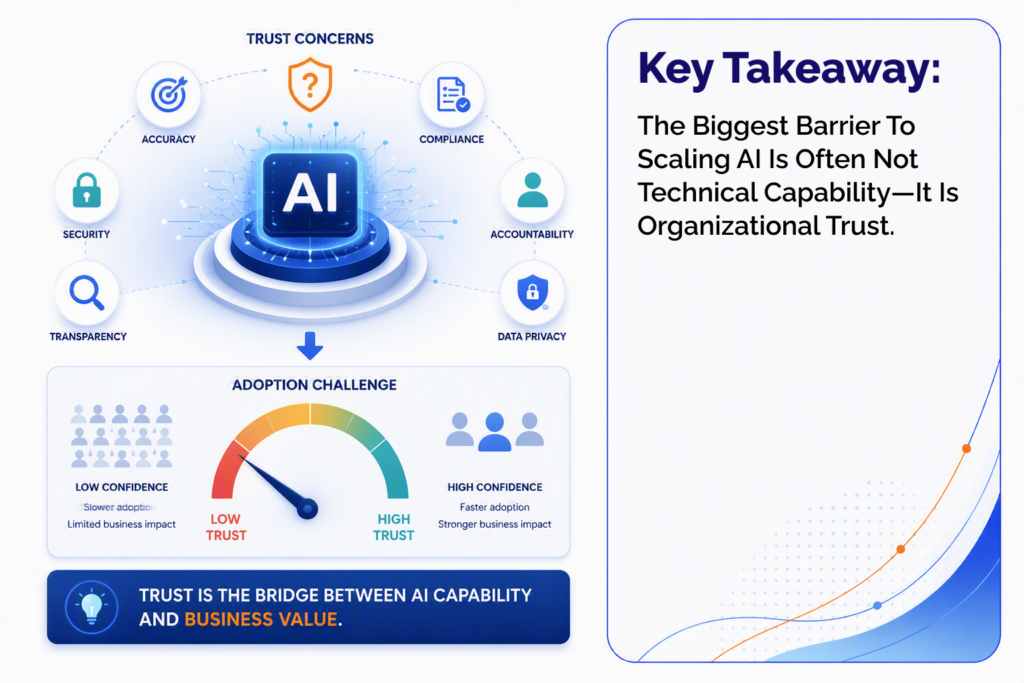
Example: A financial services organization may deploy an AI-powered assistant to help employees review client information and identify investment opportunities. Even if the recommendations are highly accurate, adoption may remain low if advisors cannot understand how the recommendations were generated or whether the underlying data can be trusted. Building confidence becomes just as important as building the solution itself.
Governance Is Not the Enemy of Innovation
One of the most common misconceptions in the market is that governance creates friction.
For years, organizations often viewed governance as a necessary control mechanism designed to reduce risk, ensure compliance, and satisfy regulatory requirements. While those objectives remain important, AI is changing how leading organizations think about governance.
Rather than seeing governance as a barrier, many organizations now view it as an accelerator.
Effective governance provides clarity. It establishes accountability. It ensures consistency. Most importantly, it creates the confidence required to adopt AI more broadly across the enterprise.
Without governance, every AI initiative becomes a separate risk discussion. Leadership teams must repeatedly evaluate the same concerns about security, compliance, data usage, and operational controls. Progress slows because trust must be rebuilt every time a new use case emerges.
With governance in place, organizations create a framework that enables innovation to happen faster.
This is one reason why many of the most mature AI programs place governance at the center of their strategy rather than treating it as an afterthought.
McKinsey’s research found that executive oversight of AI governance is closely associated with stronger business outcomes from AI investments. Organizations that establish clear governance structures, risk management processes, and leadership accountability are often better positioned to scale AI successfully. [mckinsey.com]
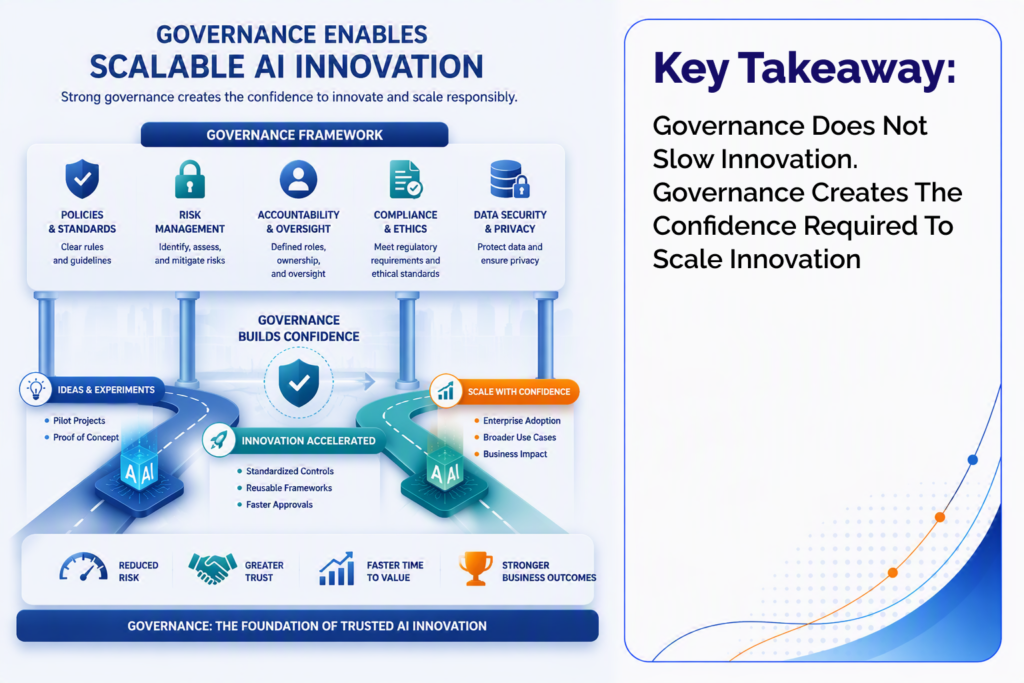
Example: A healthcare organization implementing AI-assisted claims reviews may establish governance controls around data access, auditability, human oversight, and decision transparency. While those controls add structure, they also enable the organization to expand AI usage more confidently because risks are better understood and managed.
Transparency and Human Oversight Remain Essential
One of the most interesting lessons emerging from enterprise AI adoption is that organizations are not looking to remove humans from decision-making entirely.
In fact, many leaders are seeking exactly the opposite.
Rather than pursuing fully autonomous systems, organizations are increasingly focusing on models where AI augments human expertise. AI generates recommendations, surfaces insights, and accelerates analysis, while people remain responsible for evaluating, approving, and acting on those recommendations.
This “human-in-the-loop” approach has become a critical trust-building mechanism.
Employees are more likely to adopt AI when they understand how recommendations are generated and retain the ability to review outcomes before action is taken. Customers are more likely to trust organizations that maintain accountability for final decisions. Regulators are more likely to support innovation when oversight remains visible and auditable.
Trust grows when transparency exists. When AI behaves like a black box, skepticism increases. When AI operates within clear governance boundaries, adoption becomes easier.
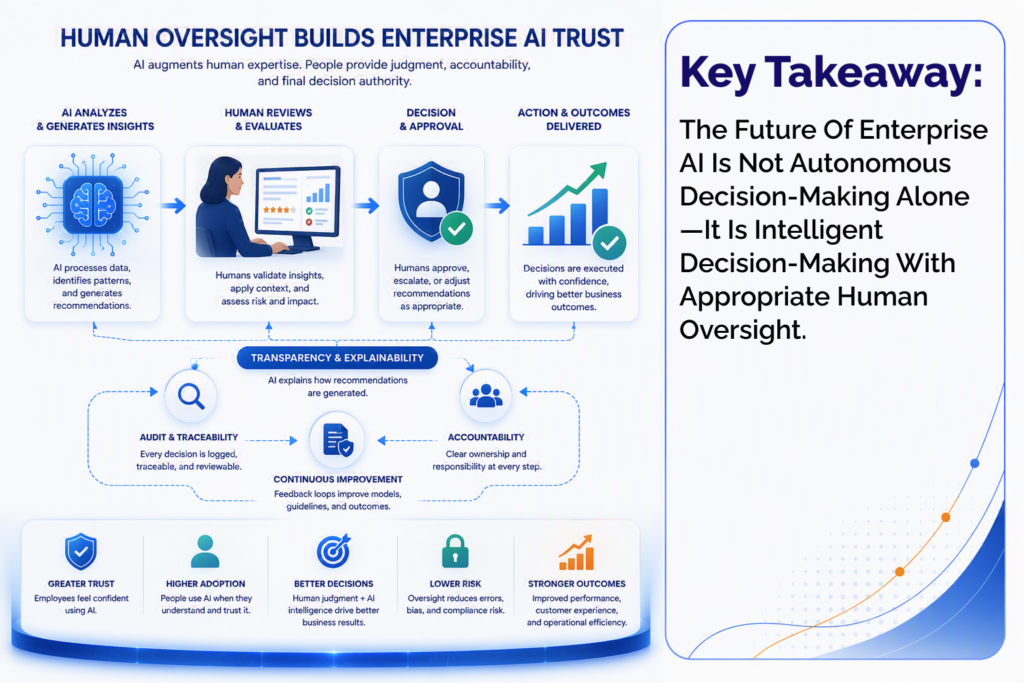
Example: A supply chain organization may use AI to recommend inventory adjustments based on demand forecasts. Rather than automatically executing every recommendation, planners review and approve proposed changes. Over time, trust in the system grows because employees can validate the recommendations while still benefiting from AI-driven speed and intelligence.
The Most Trusted Organizations Will Capture the Most AI Value
As AI becomes more accessible, technology itself will become less of a differentiator.
Most organizations will eventually have access to similar models, platforms, and capabilities. What will differentiate them is trust, and customers will favor organizations that protect data and use AI responsibly.
Employees will embrace systems they trust, partners will collaborate more effectively when governance standards are clear, and regulators will look more favorably on organizations that can demonstrate accountability.
Trust is becoming a business asset.
Just as cybersecurity evolved from a technology concern into a board-level priority, AI governance is following a similar path. The organizations that build trust into their AI strategies from the beginning will be positioned to move faster and capture greater value over time.
This is where governance evolves from a risk conversation into a competitive advantage conversation.
Organizations that establish trusted governance frameworks are not merely reducing risk. They are creating the conditions that allow AI to scale throughout the enterprise.
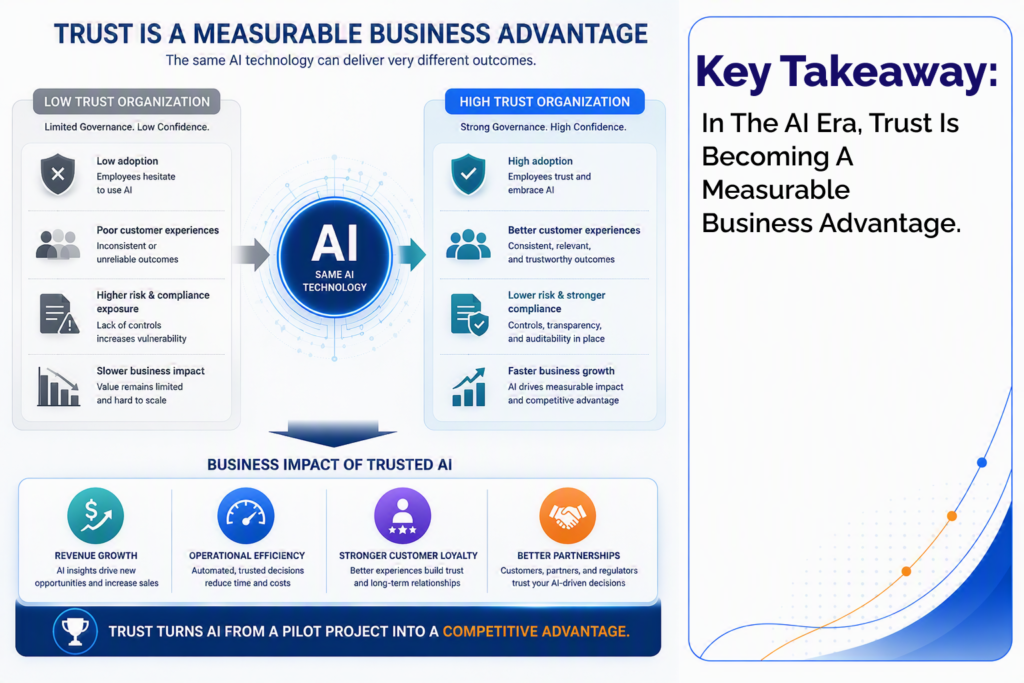
Example: Two companies may implement similar AI-powered customer service solutions. One provides transparency, human escalation paths, clear governance controls, and data protection assurances. The other does not. Over time, customers are more likely to engage with and trust the organization that demonstrates accountability, even if the underlying technology is similar.
The Opportunity Ahead
The next chapter of AI adoption will not be defined solely by advances in technology. It will be defined by the organizations that learn how to deploy that technology responsibly, transparently, and at scale.
Enterprise leaders are increasingly recognizing that AI success requires more than innovation. It requires trust. It requires governance. It requires accountability. It requires guardrails that enable both employees and customers to embrace AI with confidence.
Organizations that view governance as a strategic capability rather than a compliance requirement will be better positioned to accelerate adoption, expand AI use cases, and unlock greater business value.
The future belongs to organizations that can do both: innovate boldly and govern responsibly.
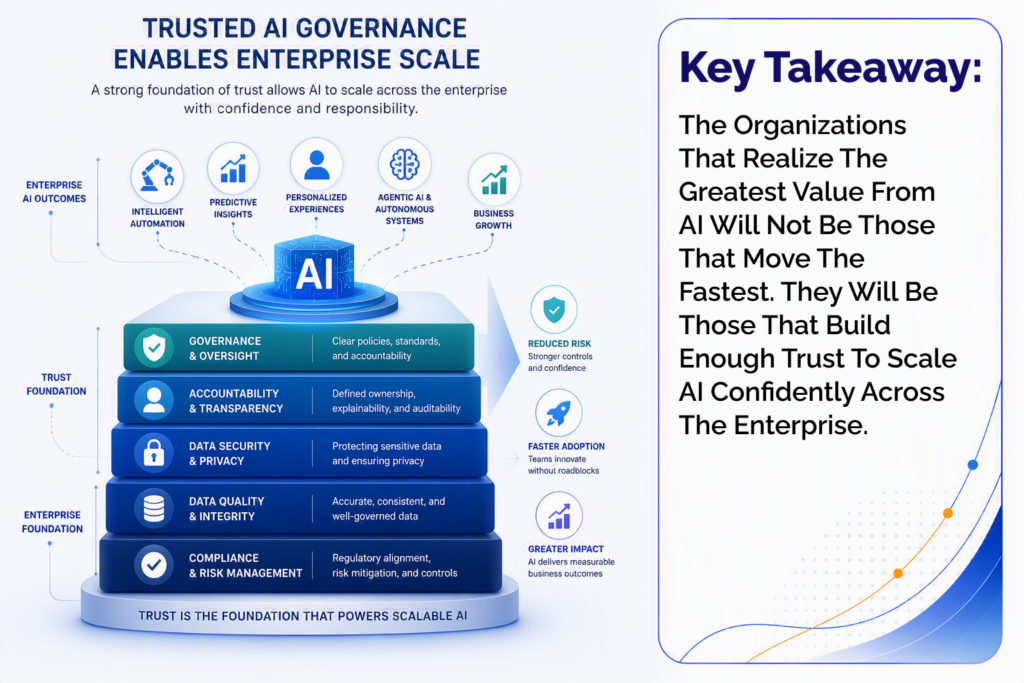
Example: As agentic and autonomous AI systems become more prevalent, organizations with mature governance frameworks will be able to adopt these capabilities more quickly because the foundations of trust, accountability, and oversight are already in place. Their competitors may have access to the same technology, but without the same level of confidence, progress will be significantly slower.