
How to Choose Enterprise AI Partners in 2026
A successful AI initiative rarely starts with AI.
It starts with business priorities, operational challenges, data readiness, integration requirements, and a clear understanding of how technology will create value. That’s why selecting the right enterprise AI implementation partner has become one of the most important decisions facing CIOs, CTOs, CDOs, and digital transformation leaders.
The best partners do far more than deploy models. They help organizations align strategy, modernize technology foundations, integrate systems, establish governance, and scale AI across complex enterprise environments.
As organizations move beyond experimentation and begin integrating AI into critical business operations, they’re evaluating a growing ecosystem of providers, from niche AI specialists to global consulting firms. The real question isn’t who has the most impressive AI tools. It’s who can operationalize AI within the realities of your organization.
Research from McKinsey highlights that enterprises increasingly seek partners capable of bridging technology, business transformation, and operational execution. Similarly, CIO.com notes that successful AI partnerships require more than technical expertise. They require strategic alignment, implementation experience, and a clear path to long-term value.
How Do You Choose an Enterprise AI Partner?
The best enterprise AI implementation partners demonstrate competency across seven critical areas:
- Strategic business alignment
- Enterprise AI transformation experience
- Systems integration capabilities
- AI governance expertise
- Data and modernization knowledge
- Proven delivery methodologies
- Long-term operational support
Organizations should prioritize partners that can connect AI initiatives to measurable business outcomes, not just technical implementation.
Enterprise AI Partner Evaluation Criteria
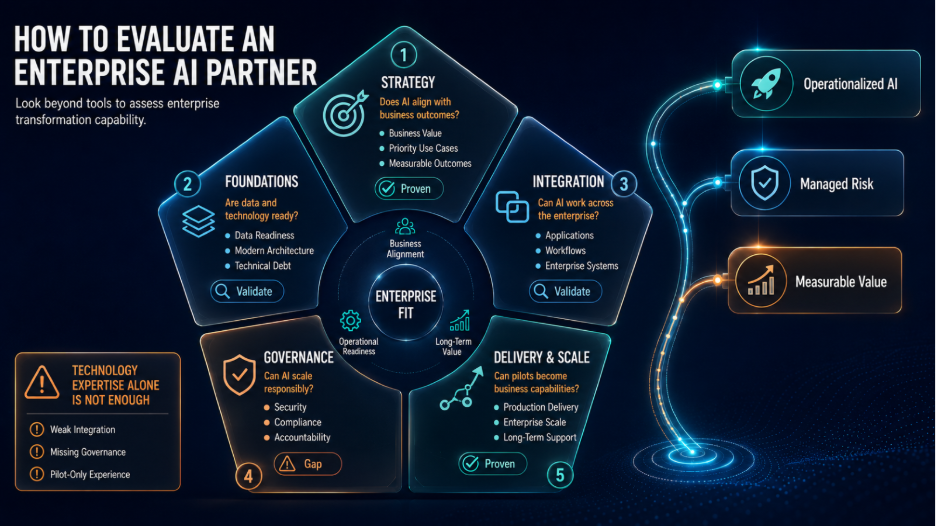
Comparing AI providers can become difficult when every proposal highlights similar platforms, accelerators, certifications, and technical credentials. A more useful approach is to evaluate potential partners across five interconnected dimensions.
Strategy
Can the partner connect AI initiatives to business outcomes, operational priorities, and measurable value?
Foundations
Does the partner understand data readiness, architecture, modernization priorities, and technical debt?
Integration
Can AI be embedded into existing applications, workflows, business processes, and enterprise systems?
Governance
Can the partner establish guardrails around security, privacy, compliance, trust, accountability, and responsible AI?
Delivery and Scale
Can the partner move beyond pilots and successfully operationalize AI across the enterprise?
The strongest partners demonstrate competency across all five dimensions. A firm with impressive AI expertise but weak integration capabilities may struggle to generate business value. Likewise, a technically strong implementation partner without governance expertise may introduce unnecessary risk.
Why Choosing the Right AI Partner Matters
Building a proof of concept is relatively straightforward.
Operationalizing AI across customer service, finance, operations, software engineering, supply chain management, and regulatory environments is significantly more challenging.
According to McKinsey, organizations creating the most value from AI are more likely to combine technology adoption with organizational change, governance models, and clear operating structures. Deloitte similarly emphasizes that successful AI programs require alignment between business strategy, technology implementation, and long-term operational management.
The strongest enterprise AI transformation initiatives typically involve:
- Data modernization
- Process redesign
- Organizational change management
- Governance frameworks
- Systems integration
- Continuous improvement
This is why selecting an AI partner should be viewed as a strategic business decision rather than a technology procurement exercise.
1. Evaluate Strategic Business Alignment First
One of the most common mistakes organizations make is evaluating AI partners based primarily on technical expertise.
Strong AI strategy consulting partners start by understanding business goals, operational challenges, and growth objectives before recommending specific technologies.
A valuable partner should help answer questions such as:
- Which AI use cases should be prioritized?
- Where can AI create measurable business value?
- What organizational barriers need to be addressed?
- Which investments should come first?
- How should success be measured?
Organizations pursuing broader AI transformation initiatives often discover that strategy and readiness matter more than technology selection during the early stages of adoption.
Questions to Ask
- How does the partner define business value?
- Can they connect AI initiatives to measurable outcomes?
- Do they understand your industry and operating model?
- Have they solved similar business challenges previously?
The best partners speak comfortably about business outcomes, not just technology platforms.
2. Look Beyond AI Expertise to Integration Expertise
AI creates value only when it works within the broader enterprise ecosystem.
Organizations should carefully assess a partner’s AI integration services capabilities because AI solutions must interact with applications, workflows, data sources, and business processes.
Look for experience integrating with:
- ERP systems
- CRM platforms
- Legacy applications
- Cloud platforms
- Enterprise data environments
- API ecosystems
- Workflow automation tools
Effective API integration often becomes a critical success factor because AI solutions rely on access to trusted enterprise systems and operational data.
Similarly, expertise in legacy application modernization can help organizations integrate AI while preserving valuable business functionality.
Warning Sign
If a partner focuses heavily on models, prompts, and AI tools but spends little time discussing integration architecture, scalability challenges may emerge later.
3. Assess Their Ability to Navigate Complex Enterprise Operations
Enterprise environments introduce operational realities that many smaller implementations never encounter.
Examples include:
- Regulatory requirements
- Global operations
- Security mandates
- Multiple technology platforms
- Department-specific workflows
- Complex approval structures
- Legacy infrastructure
Partners with experience managing complex enterprise operations are often better positioned to deliver sustainable outcomes.
For example, deploying AI in customer support may require integration with customer data platforms, CRM systems, compliance controls, knowledge management tools, reporting infrastructure, and cybersecurity frameworks.
The challenge is rarely the AI model itself.
The challenge is fitting AI into existing business operations without introducing disruption.
Key Question
Can the partner provide evidence of successful enterprise-scale deployments in organizations with similar complexity?
4. Evaluate AI Governance and Responsible AI Capabilities
As AI adoption expands, governance becomes increasingly important.
According to Microsoft, ISO, Gartner, and Deloitte, organizations that successfully scale AI establish governance frameworks that address transparency, accountability, security, oversight, and risk management from the outset.
Partners should demonstrate experience with:
- Responsible AI deployment
- Regulatory compliance
- Security frameworks
- Risk management
- Human oversight
- Monitoring and auditability
- Model governance
Organizations investing in an AI governance framework should prioritize partners capable of operationalizing governance across multiple departments and use cases.
Similarly, enterprises focused on building confidence and accountability should evaluate expertise in AI trust and enterprise AI governance.
Why This Matters
Organizations with strong governance often scale AI faster because governance creates consistency, accountability, and trust.
5. Prioritize Data and Modernization Capabilities
AI cannot overcome fragmented data, poor data quality, or outdated architecture.
Many organizations discover that modernization work must occur alongside AI initiatives to support long-term success.
Common priorities include:
- Data quality improvement
- Cloud modernization
- Platform consolidation
- Process optimization
- Analytics enhancement
- Governance improvements
Organizations investing in enterprise data analytics often strengthen the foundation required for AI initiatives because data becomes more accessible, governed, and actionable.
Likewise, eliminating data silos frequently becomes a prerequisite for enterprise-scale AI adoption.
A strong partner should also help organizations evaluate overall AI readiness before significant investments are made.
Critical Insight
The most important AI decision may not be selecting a model.
It may be identifying which modernization initiative should come first.
6. Examine Delivery Methodology and Scaling Experience
AI pilots are common.
Operationalized AI is still difficult.
The best AI consulting firms bring repeatable methodologies that support implementation, adoption, governance, optimization, and long-term success.
Evaluate capabilities such as:
- Agile delivery
- DevOps practices
- Change management
- Workforce adoption
- Monitoring and observability
- Continuous optimization
Organizations should also assess experience overcoming common AI implementation barriers because successful deployment often depends on organizational and operational readiness as much as technology.
Ask for Evidence
Request examples demonstrating:
- Production deployments
- Enterprise scalability
- Measurable business outcomes
- Governance and oversight practices
Successful AI programs should be evaluated by business impact, not proof-of-concept activity.
7. Evaluate Long-Term Partnership Potential
AI transformation is not a one-time project.
Business priorities evolve. Technologies evolve. Regulatory requirements evolve.
The strongest enterprise AI implementation partners continue creating value long after initial deployment.
Long-term partnership support may include:
- AI roadmapping
- Governance refinement
- Workforce enablement
- Model lifecycle management
- Performance optimization
- Innovation planning
Organizations building sustainable AI capabilities often benefit from a structured AI readiness foundation that supports long-term growth rather than short-term implementation goals.
Key Consideration
Choose a partner that can support where your organization intends to be in three years, not just where it is today.
Common Mistakes When Selecting AI Partners
Choosing Based on Technology Alone
Technology matters, but business alignment, governance, integration, and adoption frequently determine long-term success.
Prioritizing Cost Over Value
The lowest-cost option is not always the lowest-risk or highest-value option.
Underestimating Integration Complexity
Many AI projects encounter delays because organizations underestimate enterprise integration requirements.
Ignoring Governance Requirements
Governance should be established before deployment, not after.
Focusing Only on Pilot Success
Launching AI is only the beginning.
Scaling AI is what creates lasting business value.
Frequently Asked Questions
What should enterprises look for in an AI implementation partner?
Organizations should evaluate strategic alignment, systems integration capabilities, governance expertise, modernization experience, delivery methodologies, and long-term operational support.
How do AI consulting firms differ from technology vendors?
Technology vendors primarily provide platforms and tools. AI consulting firms help organizations align technology with business objectives, implementation strategies, governance requirements, and organizational change initiatives.
Why are AI integration services important?
AI solutions generate the greatest value when connected to existing enterprise systems, applications, workflows, and data sources. Without integration, AI often remains isolated from core business processes.
What questions should be included in an AI partner evaluation?
Key questions include:
- Can the partner demonstrate measurable business outcomes?
- Do they understand your industry?
- How do they address AI governance?
- What modernization work do they recommend?
- How do they support long-term adoption and optimization?
The Future of Enterprise AI Partnerships
The role of AI partners continues to evolve.
Organizations increasingly expect more than technical implementation. They want partners who understand strategy, modernization, governance, integration, and operational execution.
As AI becomes embedded throughout enterprise operations, successful partnerships will increasingly be defined by their ability to connect innovation with measurable business outcomes.
The organizations creating the greatest value from AI will often be those that choose partners capable of balancing innovation, governance, integration, and scale.
Conclusion
Choosing the right enterprise AI implementation partner is one of the most important decisions organizations will make as AI adoption accelerates.
The strongest partners do more than deploy technology. They help align strategy, governance, integration, data, modernization, and execution into a sustainable transformation approach.
When evaluating AI consulting firms, enterprise leaders should look beyond technical expertise and assess how effectively a partner can support enterprise AI transformation across complex business environments.
The goal is not simply to implement AI.
The goal is to operationalize AI in ways that create measurable business value, strengthen competitive advantage, reduce risk, and support long-term growth.
Organizations that choose partners with this broader perspective are often better positioned to turn AI investments into lasting business capabilities.
Key Takeaways
- Enterprise AI implementation partners should be evaluated across strategy, integration, governance, modernization, delivery, and long-term support.
- AI integration services are often as important as AI technology expertise.
- Strategic business alignment should come before technology selection.
- Governance and responsible AI capabilities are critical for scaling AI successfully.
- Data readiness and modernization often determine AI outcomes more than model selection.
- The best AI consulting firms help organizations operationalize AI across complex enterprise operations.