
How Responsible AI Deployment Reduces Enterprise Risk
Artificial intelligence is quickly becoming part of core business operations. Organizations are using AI to automate workflows, improve customer experiences, accelerate software development, enhance analytics, and support faster decision-making.
Yet many enterprise AI failures have very little to do with the technology itself.
Most failures occur because organizations deploy AI without adequate governance, oversight, accountability, or risk management.
The reality is simple: the more AI influences business decisions, the greater the consequences when something goes wrong.
A biased recommendation can impact hiring decisions. An inaccurate response can damage customer trust. An autonomous workflow can introduce operational disruptions. As AI adoption accelerates, managing these risks becomes just as important as achieving innovation.
This is why responsible AI deployment has become a strategic priority for CIOs, CTOs, CDAOs, and AI governance leaders.
Responsible AI deployment provides the governance, safety controls, ethical safeguards, and operational discipline needed to reduce risk while enabling organizations to scale AI with confidence.
How Does Responsible AI Deployment Reduce Risk?
Responsible AI deployment reduces enterprise risk by establishing governance frameworks, risk management processes, safety controls, and accountability mechanisms that help organizations identify, manage, and mitigate AI-related risks before they impact operations, customers, or business outcomes.
Organizations that deploy AI responsibly are better positioned to:
- Reduce compliance exposure
- Strengthen trust and transparency
- Improve AI reliability
- Minimize algorithmic bias
- Protect sensitive data
- Prevent uncontrolled AI adoption
- Scale AI initiatives with confidence
The goal is not to eliminate risk entirely.
The goal is to manage risk systematically so AI can be adopted safely and sustainably.
The Hidden Risks of Enterprise AI
Many organizations underestimate the scope of AI-related risk because they view AI as a technology initiative rather than an operational capability.
In reality, AI introduces risks across multiple areas of the business.
Regulatory Risk
Governments and regulators are introducing new requirements around AI transparency, accountability, data privacy, and explainability.
Organizations that deploy AI without proper governance may face compliance challenges, increased scrutiny, or legal exposure.
Reputational Risk
Trust takes years to build and seconds to lose.
Inaccurate outputs, biased recommendations, or questionable AI decisions can damage customer confidence and brand reputation.
Operational Risk
As AI becomes integrated into workflows, errors can have operational consequences.
Poorly governed AI systems can lead to:
- Incorrect recommendations
- Process disruptions
- Unintended actions
- Escalating operational inefficiencies
Security Risk
AI systems often interact with enterprise data, business applications, and employee workflows.
Without appropriate controls, organizations increase their exposure to:
- Data leakage
- Unauthorized access
- Security vulnerabilities
- Inappropriate AI usage
Strategic Risk
Perhaps the biggest risk is investing heavily in AI without creating measurable business value.
Many organizations launch pilots successfully but struggle to scale because governance, ownership, and operating models were never clearly defined in the first place.
Related reading:
Why Most AI Risk Is Not Technical
When organizations think about AI risk, they often focus on model performance.
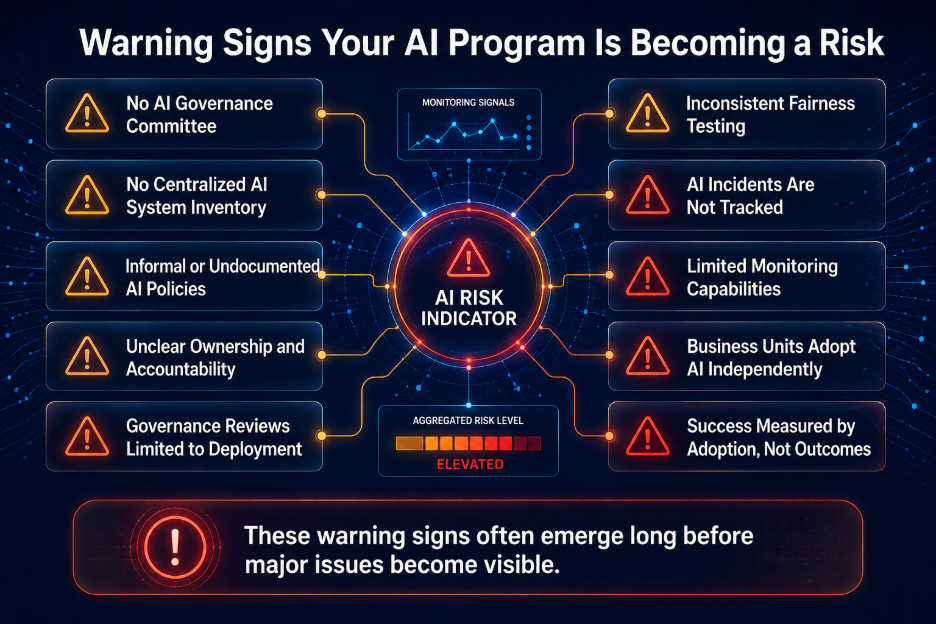
But many enterprise AI problems are governance problems.
Common examples include:
Unclear Ownership
Nobody knows who owns accountability for AI outcomes.
Shadow AI
Teams begin using AI tools without formal approval or oversight.
Poor Data Quality
AI systems inherit the weaknesses of the data they consume.
Limited Monitoring
Models perform well initially but gradually decline without detection.
Inconsistent Decision-Making
Different business units deploy AI using different standards and controls.
These issues rarely originate from the model itself.
They occur because organizations treat AI as a technology project rather than an enterprise capability.
The Cost of Ignoring Responsible AI
The consequences of weak governance are often greater than leaders initially expect.
| Risk Area | Potential Business Impact |
| Bias and Fairness Issues | Customer trust erosion |
| Poor Transparency | Regulatory scrutiny |
| Weak Governance | Failed AI initiatives |
| Data Quality Problems | Inaccurate business decisions |
| Lack of Monitoring | Model drift and declining performance |
| Security Gaps | Data exposure and compliance concerns |
| Undefined Ownership | Slow incident response |
Responsible AI deployment helps organizations address these risks before they become business problems.
The Enterprise Risk Reduction Framework
Rather than viewing governance as a compliance exercise, successful organizations approach responsible AI deployment through a structured risk management framework.
1. Identify
Understand where AI is being used.
Establish visibility into:
- AI systems
- Business use cases
- Data sources
- Responsible owners
Organizations cannot govern what they cannot see.
2. Assess
Evaluate risk levels before deployment.
Questions include:
- Could bias impact outcomes?
- Are privacy controls adequate?
- Is the data trustworthy?
- How critical is the business process?
Understanding risk upfront enables better decision-making later.
Related reading:
3. Control
Implement safeguards designed to reduce risk.
Examples include:
- Human oversight
- Approval workflows
- Security controls
- Transparency requirements
- Testing procedures
This is where responsible AI practices become operational.
4. Monitor
Risk does not disappear after deployment.
Organizations should continuously monitor:
- Model performance
- Data quality
- User behavior
- Compliance requirements
- Security indicators
Many governance programs fail because monitoring never becomes part of daily operations.
5. Improve
Responsible AI is not a one-time effort.
Organizations should continuously refine governance frameworks, update controls, improve processes, and adapt to changing regulations and technologies.
This ongoing cycle helps create long-term resilience.
From AI Governance to Business Resilience
The strongest AI programs are built on trust.
Organizations that establish clear governance frameworks can adopt AI more aggressively because stakeholders understand:
- Who is accountable
- How decisions are made
- What safeguards exist
- How risks are managed
Governance becomes an accelerator rather than an obstacle.
Helpful resources:
Executive Checklist for Responsible AI Deployment
Before scaling AI initiatives, leaders should confirm:
✅ Executive sponsor assigned
✅ Governance structure established
✅ AI inventory completed
✅ Risk assessment process defined
✅ Data governance controls implemented
✅ Security reviews completed
✅ Human oversight requirements documented
✅ Fairness testing procedures established
✅ Monitoring platform deployed
✅ Incident management process defined
✅ Compliance review mechanisms in place
✅ Business value metrics identified
Organizations that complete these foundational steps are significantly better positioned to manage enterprise AI risk at scale.
Final Thoughts
The future of AI will be shaped not only by innovation, but by trust.
Organizations that deploy AI without governance may achieve short-term gains, but they often struggle to maintain stakeholder confidence, manage risk, or scale adoption effectively.
Responsible AI deployment provides a practical framework for reducing enterprise risk while enabling long-term innovation. By combining AI governance, AI ethics, AI safety, algorithmic fairness, and AI risk management into a unified operating model, organizations can create the trust needed to move from experimentation to enterprise-wide transformation.
The question is no longer whether enterprises should deploy AI.
The question is whether they can deploy it responsibly enough to realize its full value.