
The AI Conversation Happening in Every Boardroom
Every Leadership Team Is Asking Similar Questions
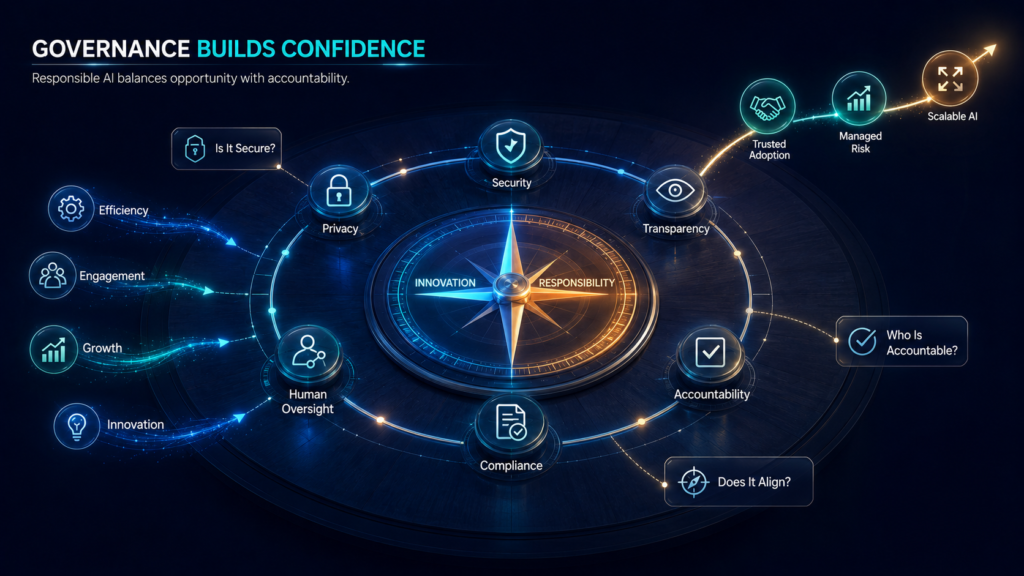
Conversations about artificial intelligence are taking place in boardrooms, executive meetings, and strategic planning sessions across every industry. Associations, nonprofits, and mission-driven organizations are exploring how AI can improve efficiency, enhance engagement, support growth, and accelerate innovation.
The excitement surrounding AI is easy to understand. Leaders are constantly searching for ways to accomplish more with limited resources while increasing the value they deliver to members, donors, and stakeholders.
At the same time, many organizations are asking equally important questions about security, privacy, transparency, accountability, and compliance.
These concerns do not indicate resistance to AI. They reflect a desire to ensure new technologies are adopted responsibly.
Why Trust Matters More Than Technology
The most successful AI initiatives are not defined solely by technical capabilities. They are defined by trust.
Employees need confidence that AI tools are being used appropriately. Members and donors expect sensitive information to be protected. Boards want assurance that AI initiatives align with organizational priorities and risk management requirements.
Without trust, even innovative projects can struggle to gain traction.
This is why governance has become such a critical component of successful AI adoption.
The Organizations Moving Fastest Are Often the Most Disciplined
Leading organizations understand that governance is not a barrier to innovation. Rather, it provides the framework that enables innovation to scale safely.
Clear policies, defined accountability, risk management processes, and responsible AI guidelines give organizations the confidence to explore new opportunities while maintaining appropriate oversight.
As a result, governance often accelerates adoption by reducing uncertainty and establishing alignment across stakeholders.
Responsible AI Is Becoming a Strategic Requirement
AI is moving quickly from experimentation to operational reality. Organizations that establish governance frameworks today will be better positioned to scale AI initiatives in the future without compromising trust, compliance, or accountability.
The organizations that succeed in the years ahead will be those that balance innovation with responsibility, creating sustainable approaches that deliver both business value and stakeholder confidence.
Key Takeaways
- AI adoption continues to accelerate across mission-driven organizations.
- Trust is essential for long-term success.
- Governance provides the foundation for responsible AI adoption.
- Leading organizations use governance to enable innovation.
- Responsible AI balances opportunity with accountability.
Actionable Next Steps
Assess how AI is currently being used within the organization and identify governance gaps that may exist. Develop policies and frameworks that address security, privacy, transparency, compliance, and accountability while supporting future innovation goals.
How CEI Can Help
CEI helps organizations build practical AI governance frameworks that support innovation, compliance, risk management, and responsible adoption, enabling leaders to pursue AI opportunities with confidence.