
Why Your Best Donors and Members May Be Ignoring You
Engagement Isn’t Declining Because People Care Less
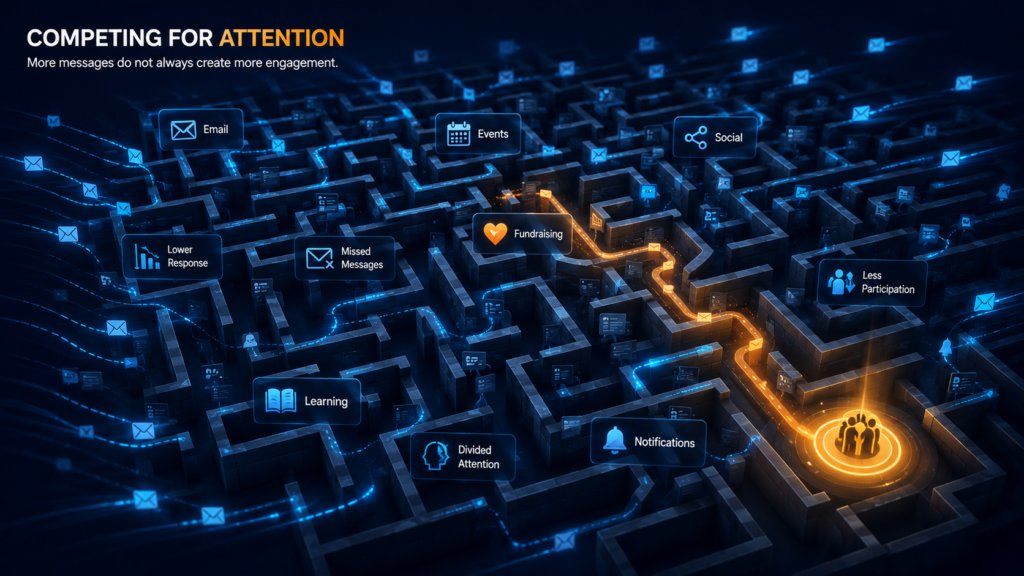
Many membership and nonprofit leaders worry that engagement levels are not what they once were. Email campaigns receive fewer responses, event participation becomes harder to drive, and fundraising efforts require greater effort to achieve comparable results. It can be tempting to assume that audiences have become less interested, but the reality is often much different.
Members, donors, and constituents are navigating an environment filled with competing priorities and constant information. Every day they receive messages from organizations, businesses, media outlets, and professional networks that are all competing for attention. Even individuals who are highly committed to a mission may struggle to engage with every communication they receive.
The challenge facing organizations today is not a lack of audience interest. The challenge is ensuring that communications remain relevant enough to break through the noise.
Why Traditional Communication Strategies Are Losing Effectiveness
Most organizations understand their audiences at a broad level. They know who their members are, what programs they support, and which initiatives have historically performed well. However, broad audience understanding is no longer enough.
Members and donors increasingly expect interactions that align with their interests, goals, and experiences. Yet many organizations still communicate with audiences as though everyone shares the same motivations and priorities.
Over time, generalized messaging becomes less effective because it fails to reflect the unique needs of the people receiving it. Organizations often respond by increasing communication volume, only to discover that relevance has a far greater influence on engagement than frequency.
How Leading Organizations Are Creating More Meaningful Connections
Organizations that are successfully improving engagement are not necessarily sending more communications. Instead, they are creating more personalized experiences.
AI is helping organizations better understand audience behavior by analyzing participation patterns, communication preferences, event attendance, content engagement, and donor activity. These insights allow organizations to create interactions that feel more relevant without placing additional demands on staff.
The result is a stronger connection between organizations and the people they serve. Members receive information that aligns with their interests. Donors engage with initiatives that reflect their priorities. Constituents experience communications that feel more valuable because they are more relevant.
The Future of Engagement Is Personal
As competition for attention continues to grow, personalization will become a defining characteristic of successful organizations. Those that can better understand the people they serve will be positioned to build stronger relationships, improve retention, and increase participation across every aspect of the organization.
AI is making that level of understanding increasingly achievable by helping organizations transform audience data into meaningful engagement strategies.
Key Takeaways
- Audiences are overwhelmed with information and choices.
- Relevance is becoming more important than communication volume.
- AI helps organizations better understand member and donor behavior.
- Personalized engagement strengthens relationships and participation.
- Stronger engagement supports fundraising, retention, and growth.
Actionable Next Steps
Evaluate how audiences are currently segmented and how communications are personalized across the organization. Identify opportunities to align messaging with engagement patterns, interests, and behaviors to create more meaningful constituent experiences.
How CEI Can Help
CEI helps organizations leverage AI-powered engagement strategies that improve audience understanding, personalize communications, and strengthen long-term relationships with members, donors, and constituents.