
Why Databricks Genie Fails Without a Context Layer (And How to Build One)
Genie demos are seductive. You type a question in plain English and get a chart back in seconds. No SQL, no analyst in the loop. It looks like the future of self-service analytics has finally arrived.
Then you point it at a real warehouse. You ask for net revenue last quarter, and it hands you a number that is confidently wrong. Not broken. Wrong. Which is worse, because wrong looks exactly like right until someone in finance catches it three weeks later.
I want to be clear about where the fault sits because most teams get this backwards. The tool is not the problem. The context is.
Genie is only as good as the information you’ve given it about your business, and most organizations skip that part entirely before blaming the model when answers begin to drift. The context layer is the difference between a slick demo and a system your people can trust with numbers that end up in a board presentation.
What Genie Is Actually Doing Behind the Scenes
Understanding how Genie works explains nearly every failure mode that follows.
When you ask a question, Genie translates that request into SQL and executes it against your data. To make that translation, it relies on whatever signals are available: table names, column names, metadata comments, sample values, instructions you’ve configured, and example queries you’ve provided.
That is essentially the entire world Genie has available to reason from.
When those signals are incomplete, inconsistent, or missing, the model doesn’t stop to ask for clarification. Instead, it fills in the gaps using patterns learned from general data environments rather than from the specific business meaning that exists within your organization.
That gap between general knowledge and your business reality is where most bad answers originate.
Four Common Failure Modes
Across client engagements, I tend to see the same handful of issues repeated over and over.
1. Ambiguous Metrics
Imagine you have three tables that reference revenue. One contains gross revenue, another contains net revenue after returns, and a third contains a finance-adjusted version used only for official reporting.
A user asks for revenue, and Genie quietly selects one of those sources.
It will not necessarily explain why it chose that table or warn the user that multiple valid definitions exist. The resulting chart looks complete and professional, even if the underlying logic is wrong. Often, nobody realizes there’s a problem until someone attempts to reconcile the numbers downstream.
2. Undocumented Joins and Data Grain
Genie sees two tables that appear related and joins them together. The query executes successfully, and the result looks perfectly reasonable.
The problem is that reasonable is not the same thing as correct.
If the data grain doesn’t align or the relationship between those tables isn’t documented, the query can introduce duplication and inflate results. Nothing in the output alerts users that the join was inappropriate because, from the model’s perspective, it successfully generated working SQL.
3. Business Definitions That Live Outside the Schema
Most organizations rely on business terminology that never actually exists in the data model.
Take the phrase “active customer.” The term is used in meetings, presentations, and executive dashboards every day. Yet the schema may contain no column called active customer. Instead, the definition might depend on a combination of login activity, subscription status, account standing, and other business rules that exist only in documentation or in the minds of a few experienced analysts.
Genie cannot infer tribal knowledge. It approximates instead, and those approximations often drift away from what the business actually intends.
4. Plausible but Incorrect Aggregations
This is the failure mode that concerns me most.
Genie averages something that should have been summed. It performs a distinct count on the wrong field. It calculates a metric correctly from a SQL perspective but incorrectly from a business perspective.
The resulting number looks believable. It appears on a clean visualization and passes the initial smell test. Plausible but incorrect results are dangerous because they rarely trigger alarms. Most people don’t challenge a number that looks reasonable.
A Real-World Example
Consider a retailer asking Genie for same-store sales growth.
Marketing defines a same store as any location that has been operating for at least six months. Finance requires a full fiscal year before a location qualifies. Operations excludes stores that underwent major renovations during the reporting period.
All three groups use the exact same phrase: “same-store sales.” The problem is that none of those definitions exist in the underlying schema.
Without a context layer, Genie has no reliable way to determine which interpretation is appropriate for the question being asked. It may generate a technically valid query while producing an answer that conflicts with how the business actually defines the metric.
The model did not fail. The business definition was never encoded in a way the model could understand.
The Root Cause: Context Failure, Not Model Failure
Notice the pattern across all of these examples. None of them are actually model failures.
In each case, the model did exactly what it was asked to do using the information available to it. The real issue is that the business context required to answer the question correctly was never formally documented.
These are context failures wearing the costume of tool failures.
What a Context Layer Actually Means
So what fixes the problem? A context layer.
The term gets used frequently, so it’s worth defining precisely. A context layer is the structured collection of business meaning that sits between raw data and the model. It includes semantic definitions, certified metrics, trusted joins, example queries, governance rules, and natural-language instructions that help the model understand what your business actually means when it uses specific terms.
One way to think about it is this: Your raw tables provide vocabulary. The context layer provides grammar and intent.
Without that layer of meaning, the model pieces information together and hopes it arrives at the correct answer. With it, Genie understands that revenue refers to a specific approved metric, that active customer follows a documented definition, and that particular tables should only be joined in approved ways at specific levels of granularity.
The context layer is where business meaning gets written down so the model can stop guessing.
Building a Context Layer in Databricks
The good news is that Databricks already provides many of the capabilities needed to build a strong context layer.
Start with Unity Catalog Metadata
Unity Catalog is the foundation. Add meaningful comments to tables and columns. Don’t simply repeat the column name. Explain what the field represents, the level of granularity it captures, and any business rules that govern its use.
Tag and certify assets that are approved for business consumption. Because Genie reads this metadata directly, every additional description helps improve future responses.
Define Business Rules in Genie Instructions
Each Genie Space supports custom instructions, making it an ideal location to document business logic that doesn’t live inside the schema.
Specify authoritative sources for key metrics. Define important business terms. Document approved joins and known exceptions.
A helpful exercise is to imagine you’re onboarding a new analyst. Everything you would tell them during their first week to prevent common mistakes should likely be included in your Genie instructions.
Provide Trusted SQL Examples
Genie also learns from examples. Create certified SQL examples for your most common business questions and reporting scenarios. When users ask similar questions, Genie can reference proven patterns instead of generating entirely new logic.
This simple step eliminates many of the issues associated with ambiguous metrics and inconsistent calculations.
Curate Sample Values and Trusted Assets
Sample values play an important role in helping Genie understand the contents of a dataset.
Make sure the data being exposed is representative of normal business conditions and not unusual edge cases. At the same time, clearly identify trusted assets so the model consistently prioritizes production-ready sources over staging tables or temporary datasets.
Centralize Metric Definitions
Whenever possible, define critical business metrics once and reuse them everywhere.
One approved definition of net revenue will always outperform ten separate queries that interpret the metric slightly differently. Consistency reduces confusion and builds confidence in the answers users receive.
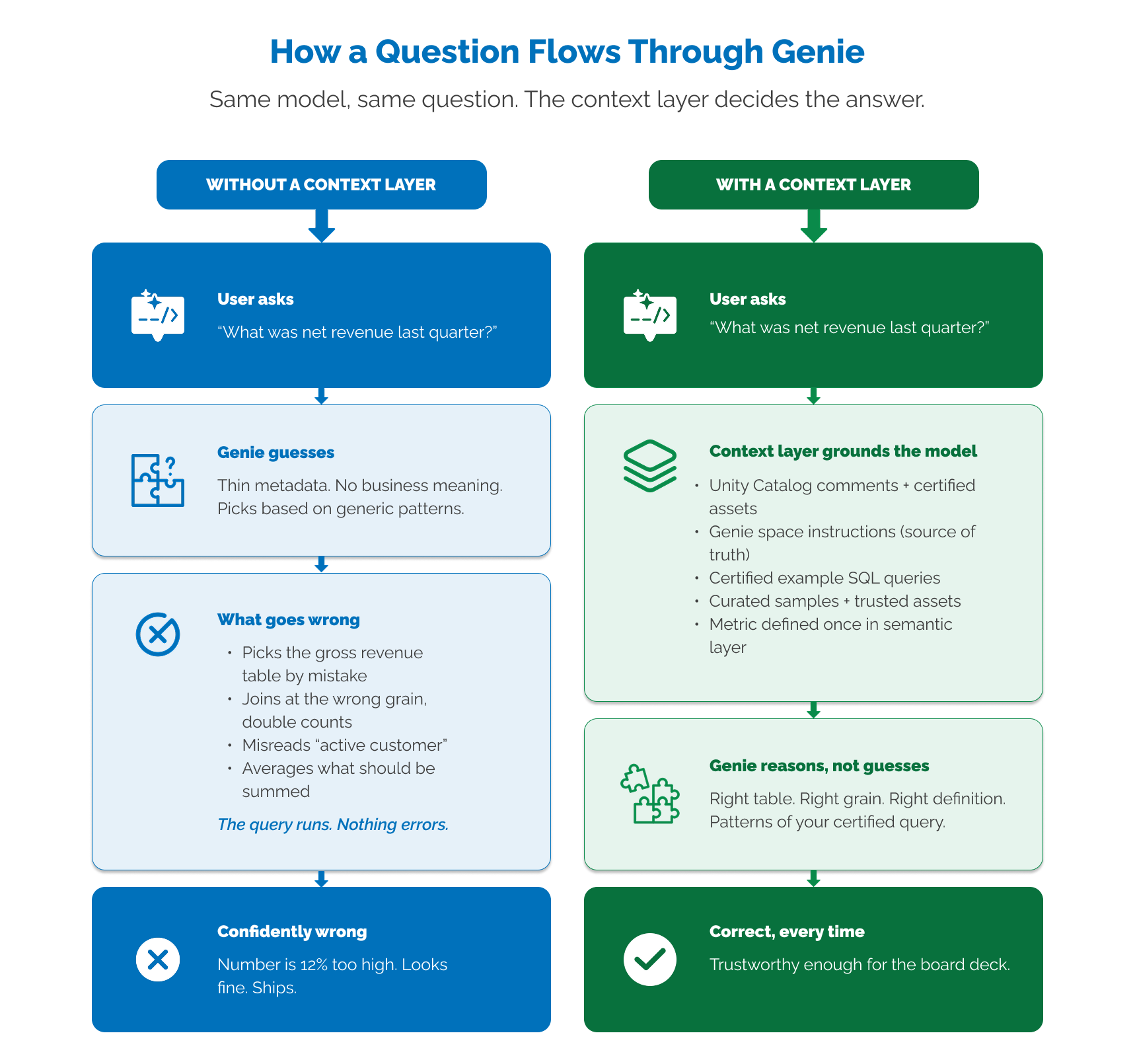
Before and After: The Same Question, Different Result
The value of a context layer becomes clear when comparing outcomes.
Before Context
A user asks: “What was net revenue last quarter?”
Genie finds three revenue-related tables, selects the wrong source, joins it to an orders table at the incorrect grain, and returns a number that is twelve percent too high. The chart appears professional and the result seems believable, so the number ultimately finds its way into a presentation.
After Context
The Genie Space identifies the certified net revenue view as the official source. Approved SQL examples demonstrate the correct logic, and the metric definition is managed centrally within the organization’s semantic framework.
The user asks the same question and the same model generates the answer.
The difference is that Genie now understands the business context behind the request. Instead of guessing, it follows documented definitions and trusted logic.
The result is accurate, repeatable, and aligned with how the business measures performance.
Context Layers Are Governance Layers
This is the point I most want practice leaders, data leaders, and CDOs to consider. A context layer is not just a technical artifact. It is also a governance artifact.
The moment an organization declares a source of truth for revenue, it has made a governance decision. Someone needs to own that decision, certify the definition, and ensure it evolves as the business changes.
Organizations should answer several questions early:
- Who owns metric definitions?
- Who approves changes?
- How are new datasets incorporated into existing definitions?
- How often are definitions reviewed?
- Who is accountable when context becomes outdated?
If you treat the context layer as a one-time implementation task, it will slowly decay. If you treat it as a governed asset with clear ownership and accountability, its value compounds over time.
This is where data governance and AI strategy stop being separate conversations and become the same conversation.
What About Genie Ontology?
It is worth addressing the obvious question. Databricks has now introduced Genie Ontology, an automatic context layer that extracts knowledge from tables, queries, dashboards, and pipelines and organizes it into a graph of how the business works. If you have read this far, that should sound familiar. It is the same argument this post is making, and it is a strong signal that the industry is converging on context as the real problem.
But automatic extraction does not remove the need for governance. It raises the stakes. An ontology built automatically is only as trustworthy as the assets it learns from. If your certified metrics are unclear, your definitions conflict, or nobody owns the source of truth, automatic extraction will simply learn and amplify that ambiguity at scale. The tooling is getting better. The discipline underneath it still has to be there. A governed, human-curated context layer is what turns automatic extraction from a risk into an advantage.
The Competitive Advantage Most Organizations Miss
Anyone can enable Genie. It’s a feature.
The organizations that succeed with self-service AI are not the ones that simply purchased the platform. They are the ones that invested in the business meaning that sits underneath it.
Your competitors can buy the same technology tomorrow. What they cannot buy is your semantic layer, your certified metrics, your governance practices, or the years of institutional knowledge encoded into your data estate.
That is the part that is genuinely difficult to replicate.
The future of self-service analytics will not be won by organizations with the best AI model. It will be won by organizations with the clearest understanding of their business and the discipline to encode that understanding into a governed context layer.
The tool is the easy ten percent.
The context is the ninety percent that ultimately determines whether any of this works.
Start there.
This context-layer-first approach is how the CEI data practice runs Databricks engagements, from migration through production AI. If you’re evaluating Genie for self-service analytics and want to build the right foundation from day one, we’d be happy to talk.