
How to Design an Enterprise AI Operating Model
Artificial intelligence has moved beyond experimentation. Across industries, organizations are deploying AI to improve customer experiences, accelerate software development, automate operations, enhance analytics, and support decision-making.
Yet despite significant investments in AI technologies, many organizations struggle to scale beyond isolated pilots.
The problem is rarely the models.
Most enterprises already have access to powerful AI platforms, cloud infrastructure, and large language models. What separates successful AI leaders from organizations stuck in experimentation is the operating model that surrounds the technology.
Research from McKinsey, Deloitte, and Gartner consistently highlights the same reality: organizations that generate measurable business value from AI invest not only in technology, but also in governance, operating structures, delivery models, and organizational transformation.
This is why enterprise leaders are increasingly focused on building an effective enterprise AI operating model.
A well-designed operating model creates the structure, accountability, processes, and governance necessary to operationalize AI and scale adoption confidently across the organization.
What Is an Enterprise AI Operating Model?
An enterprise AI operating model defines how an organization governs, develops, delivers, manages, and scales AI capabilities across the business.
Rather than focusing solely on technology, an AI operating model aligns:
- Business strategy
- Governance and risk management
- Data and technology platforms
- Organizational structure
- Delivery and execution processes
- Responsible AI practices
The goal is simple: create a repeatable framework that turns AI investments into measurable business outcomes.
A strong operating model helps answer critical questions:
- Who owns AI initiatives?
- How are AI investments prioritized?
- How are risks assessed and managed?
- How are AI solutions deployed and supported?
- How are governance and compliance enforced?
- How will successful use cases scale across the enterprise?
Without clear answers to these questions, AI initiatives often remain disconnected, creating inefficiencies, duplicated efforts, governance challenges, and limited business impact.
Why Most AI Programs Fail to Scale
Many organizations begin their AI journey with enthusiasm.
Marketing adopts generative AI.
Customer service experiments with AI assistants.
IT introduces copilots.
Operations tests intelligent automation.
Initial pilots often deliver promising results. However, scaling those successes across the enterprise requires more than technology.
Organizations frequently encounter challenges such as:
- Disconnected AI initiatives
- Unclear ownership
- Inconsistent governance
- Shadow AI usage
- Data quality issues
- Security concerns
- Duplicate investments
- Limited visibility into outcomes
The organizations achieving sustainable success treat AI as an operating model, not as a collection of isolated technology projects.
AI scales when organizations build the platforms, governance structures, operational processes, and delivery capabilities necessary to support it.
Why the Operating Model Matters
The AI conversation has evolved significantly over the past few years.
Most enterprises are no longer asking whether they should adopt AI.
Instead, they are asking:
- How do we operationalize AI?
- How do we govern AI responsibly?
- How do we scale AI across business functions?
- How do we generate measurable value from AI investments?
Research from leading industry analysts consistently demonstrates that organizational readiness is one of the strongest predictors of AI success.
The lesson is clear.
AI success is rarely constrained by model availability.
It is often constrained by execution, governance, and organizational alignment.
An effective operating model provides the structure necessary to bridge the gap between AI experimentation and enterprise-scale transformation.
The CEI Enterprise AI Operating Model Framework
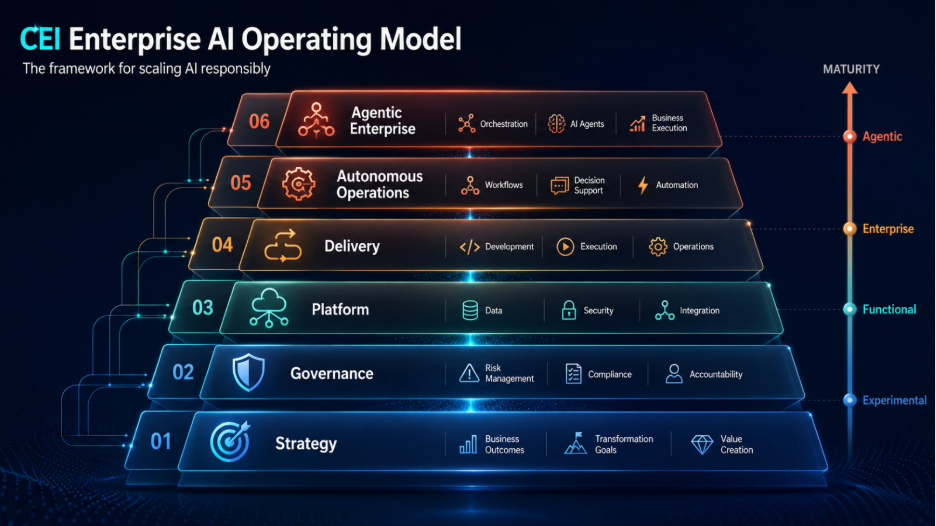
Based on our experience helping enterprises evolve from experimentation to large-scale adoption, successful AI programs tend to share six foundational layers.
Together, these layers form the CEI Enterprise AI Operating Model Framework.
| Layer | Purpose |
| Strategy | Align AI investments with business objectives and transformation goals |
| Governance | Establish accountability, decision rights, compliance, and risk management |
| Platform | Build data, cloud, AI, security, and integration foundations |
| Delivery | Operationalize AI through product teams, engineering practices, and execution models |
| Autonomous Operations | Enable AI-powered workflows, decision support, and intelligent automation |
| Agentic Enterprise | Scale governed AI agents capable of executing business actions and orchestrating work |
Each layer builds upon the previous one.
Organizations that focus only on technology often struggle to generate lasting value.
Organizations that align all six layers establish an operating model capable of scaling AI responsibly across the enterprise.
The Six Core Components of an Enterprise AI Operating Model
1. Business Strategy and AI Alignment
Every successful AI operating model starts with business strategy.
AI should not exist as a separate technology initiative.
It should directly support organizational objectives such as:
- Revenue growth
- Cost optimization
- Customer experience improvements
- Employee productivity
- Operational efficiency
- Competitive differentiation
Organizations frequently accelerate success when AI initiatives align with broader AI transformation strategy.
Key questions include:
- Which business problems create the greatest value?
- Where can AI have the largest impact?
- How will success be measured?
- How does AI support long-term strategic goals?
When AI investments are aligned with business outcomes, scaling becomes significantly easier.
2. Governance and Risk Management
Governance is a foundational element of every AI operating model.
As AI adoption expands, organizations need clear controls that define:
- Accountability structures
- Decision rights
- Approval processes
- Risk ownership
- Compliance requirements
- Security policies
Organizations seeking enterprise-wide adoption often benefit from establishing robust frameworks for AI governance at scale.
Effective governance enables innovation while maintaining trust, transparency, compliance, and organizational control.
3. Data and Platform Foundations
AI is only as effective as the data and platforms behind it.
Organizations need reliable foundations that include:
- Data governance
- Cloud architecture
- AI development platforms
- Integration capabilities
- Security controls
- Monitoring solutions
Before expanding AI initiatives, many organizations evaluate their overall AI readiness assessment.
Without a strong platform foundation, AI initiatives often struggle to scale beyond isolated pilots.
4. Organizational Structure and Talent
Technology alone does not create successful AI programs.
Organizations must establish structures that support collaboration between:
- Business leaders
- IT teams
- Data scientists
- Security teams
- Risk management
- Legal and compliance stakeholders
Leading enterprises frequently establish:
- AI Centers of Excellence (CoEs)
- Governance councils
- AI steering committees
- Cross-functional product teams
Clear roles and responsibilities help improve accountability, decision-making, and execution speed.
5. AI Delivery and Execution
The operating model should clearly define how AI solutions move from concept to production.
This includes:
- Use case prioritization
- Solution design
- Development standards
- Testing procedures
- Deployment processes
- Performance monitoring
As organizations mature, many shift from simple automation toward autonomous execution models.
A useful example is the Autonomous IT Operating Model, which demonstrates how AI agents, governance controls, operational workflows, and intelligent automation can work together to improve enterprise operations.
The focus should remain on outcomes rather than technology deployment alone.
6. Responsible AI and Enterprise Scale
Responsible AI has become a critical operating model requirement.
Organizations must address:
- Fairness
- Transparency
- Explainability
- Privacy
- Security
- Accountability
Successful organizations embed responsible AI practices directly into operating processes rather than treating them as separate initiatives.
Establishing standards for responsible AI deployment helps organizations maintain trust while scaling AI adoption.
AI Operating Model Maturity Framework
Most organizations evolve through predictable stages of maturity.
Level 1: Experimental
Characteristics include:
- Isolated pilots
- Limited governance
- Department-specific initiatives
- Minimal operationalization
Level 2: Functional
Characteristics include:
- Repeatable use cases
- Emerging governance controls
- Growing AI adoption
- Initial operating processes
Level 3: Enterprise
Characteristics include:
- Standardized AI platforms
- Centralized governance
- Cross-functional ownership
- Consistent delivery models
Level 4: Agentic Enterprise
Characteristics include:
- Governed AI agents
- Autonomous workflows
- Continuous monitoring
- AI-driven execution
- Enterprise-wide intelligence orchestration
Organizations progressing through these stages move from experimentation toward AI-enabled business execution.
From AI Operating Models to Agentic Enterprises
A major shift is reshaping enterprise AI.
Traditional AI systems focus on recommendations and insights.
Emerging AI systems increasingly take action.
AI agents can now:
- Initiate workflows
- Route tasks
- Interact with enterprise systems
- Execute approved actions
- Coordinate multi-step business processes
This evolution creates new governance, compliance, and accountability requirements.
Organizations exploring advanced autonomy should consider frameworks such as the AI Autonomy Framework: Governing A0-A4 in the Enterprise, which provides a structured approach for aligning AI autonomy levels with appropriate controls.
The future operating model will not simply govern AI applications.
It will govern AI-enabled execution.
A Practical Roadmap for Building an Enterprise AI Operating Model
Stage 1: Assess Current Readiness
Evaluate:
- Existing AI adoption
- Governance maturity
- Talent capabilities
- Platform readiness
- Risk exposure
A strong AI readiness foundation helps organizations identify critical gaps before large-scale deployment begins.
Stage 2: Define Operating Model Design
Establish:
- Governance structures
- Ownership models
- Funding approaches
- Delivery models
- Risk management processes
Stage 3: Build Delivery Capabilities
Implement:
- AI platforms
- Delivery standards
- Development workflows
- Governance controls
- Operating procedures
Stage 4: Scale and Optimize
Continuously improve:
- Governance processes
- Talent capabilities
- Responsible AI practices
- Technology foundations
- Business outcomes
AI operating models should evolve alongside organizational maturity.
Frequently Asked Questions
What is an enterprise AI operating model?
An enterprise AI operating model defines how organizations govern, develop, deploy, manage, and scale AI capabilities across the business.
How is an AI operating model different from AI strategy?
AI strategy defines what an organization wants to achieve. The operating model defines how those goals are executed through governance, processes, technology, and organizational structures.
Why do AI initiatives often fail to scale?
Many organizations focus heavily on technology but lack governance, ownership, delivery processes, organizational alignment, and operational controls.
Who owns an enterprise AI operating model?
Ownership is typically shared across executive leadership, CIOs, CTOs, CDAOs, governance councils, business stakeholders, and platform teams.
What role does governance play in an AI operating model?
Governance establishes accountability, decision rights, risk management processes, compliance controls, and oversight mechanisms that allow AI to scale responsibly.
What organizational structure works best for enterprise AI?
Many organizations adopt a hybrid approach that combines centralized governance and platform teams with decentralized business execution.
How does responsible AI fit into an operating model?
Responsible AI principles should be embedded throughout the operating model, including development, governance, deployment, monitoring, and risk management processes.
What metrics should leaders track?
Common metrics include:
- AI adoption rates
- Productivity improvements
- Business value generated
- Governance compliance rates
- User engagement
- Risk incidents
- Operational efficiency gains
How do agentic AI systems change operating models?
Agentic AI introduces autonomous execution capabilities that require stronger governance, runtime monitoring, human oversight, and accountability frameworks.
What is the future of enterprise AI operating models?
Future operating models will increasingly support autonomous workflows, governed AI agents, decision orchestration, and enterprise-wide intelligent execution.
Conclusion
The conversation around AI is changing.
Organizations are no longer asking how to experiment with AI.
They are asking how to operationalize it, govern it, and scale it across the enterprise.
The organizations generating the greatest value from AI are building more than use cases.
They are building operating models.
The most effective enterprise AI operating models combine strategy, governance, technology, talent, delivery, and responsible AI into a unified framework for sustainable growth. Increasingly, they also prepare organizations for a future where autonomous systems and AI agents become active participants in business execution.
Organizations that build these capabilities today will be better positioned to accelerate innovation, govern risk effectively, and evolve toward the Agentic Enterprise.
Key Takeaways
- An enterprise AI operating model provides the structure required to scale AI successfully.
- Governance, risk management, and responsible AI are essential operating model components.
- Technology alone does not ensure AI success; organizational alignment is equally important.
- The CEI Enterprise AI Operating Model Framework connects strategy, governance, platforms, delivery, autonomous operations, and agentic execution.
- Organizations mature through predictable stages, from experimentation to the Agentic Enterprise.
- Enterprises that establish strong operating models are better positioned to transform AI investments into measurable business outcomes.