
Why Most AI Investments Will Never Deliver Business Value And what leading enterprises are doing differently.
There was a time, not long ago, when simply having an AI strategy was enough to signal innovation. Organizations were eager to explore generative AI, machine learning, automation, and advanced analytics. Boardrooms were filled with discussions about what AI might make possible, technology teams were launching pilots at a rapid pace, and nearly every industry conference highlighted AI as the next competitive differentiator.
Today, the conversation has evolved.
Enterprise leaders are no longer asking whether AI can generate content, automate tasks, or analyze data. Those capabilities are increasingly assumed. The more important question now is how AI can improve business performance. Organizations want to know how AI will help increase revenue, improve employee productivity, strengthen customer experiences, reduce operational costs, accelerate decision-making, and create measurable competitive advantage.
That shift represents an important turning point in the market. According to McKinsey’s State of AI research, adoption continues to accelerate across industries, yet many organizations are still working to translate AI investments into meaningful enterprise-wide value. The companies seeing the strongest outcomes are not necessarily those deploying the most AI solutions. They are the organizations integrating AI into workflows, aligning initiatives to business objectives, and transforming the way work gets done. [mckinsey.com], [mckinsey.com]
As organizations move beyond experimentation and into execution, AI is increasingly being evaluated the same way every other strategic business investment is evaluated: by the outcomes it delivers.
The Market Is Moving Beyond AI Experimentation
The first wave of enterprise AI adoption was fueled by curiosity. Organizations wanted to understand what AI could do, where it could be applied, and how it might affect operations. Pilot projects emerged across customer service, software development, data analytics, content creation, and business operations. Success was often measured by proving that the technology could work.
That was a necessary phase of the journey. New technologies always require experimentation before they can scale. But eventually every pilot reaches the same crossroads: once the technology has demonstrated value, leadership begins asking what business impact it has created.
That question is becoming increasingly common across industries. Executive teams are looking beyond the novelty of AI and focusing on measurable outcomes. Instead of celebrating deployment milestones, organizations are evaluating improvements in customer satisfaction, productivity, efficiency, risk reduction, and growth.
The market is no longer rewarding companies simply for implementing AI. It is rewarding organizations that can demonstrate meaningful business results.
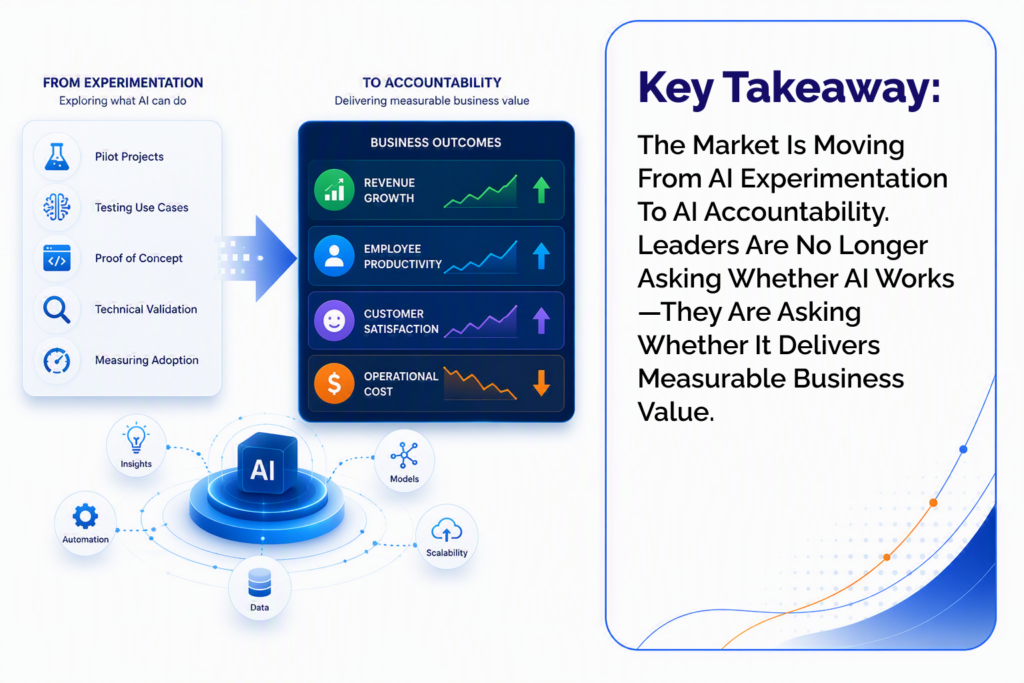
Example: Consider a financial services organization that implemented a generative AI assistant for customer service teams. During the pilot phase, success may have been measured by response accuracy and user adoption. Today, leadership is more likely to focus on metrics such as reduced call handling times, improved customer satisfaction, increased agent productivity, and lower service costs. The technology remains important, but business outcomes have become the primary measure of success.
Why So Many AI Initiatives Struggle to Produce Results
One of the most common misconceptions surrounding AI is the belief that deploying technology automatically creates transformation.
In reality, technology implementation is often the easiest part of the journey.
Many organizations successfully launch AI initiatives only to discover that underlying business processes remain unchanged. Insights may be generated faster, yet decisions are still delayed. Recommendations may be highly accurate, yet employees may not trust them. Automated workflows may reduce manual effort, yet operational inefficiencies continue elsewhere in the process.
This gap between technical success and business success explains why so many AI programs struggle to scale.
Organizations frequently focus on technology while underestimating the importance of operational change. AI can surface opportunities, but value is only created when those opportunities lead to action. Productivity improves when employees change how they work. Efficiency improves when decisions happen faster. Customer experiences improve when processes become simpler and more responsive.
McKinsey’s research suggests that organizations achieving higher levels of AI value are significantly more likely to redesign workflows and operating models as part of their transformation efforts. Rather than layering AI on top of existing processes, they use AI as an opportunity to rethink how work happens. [mckinsey.com], [mckinsey.com]
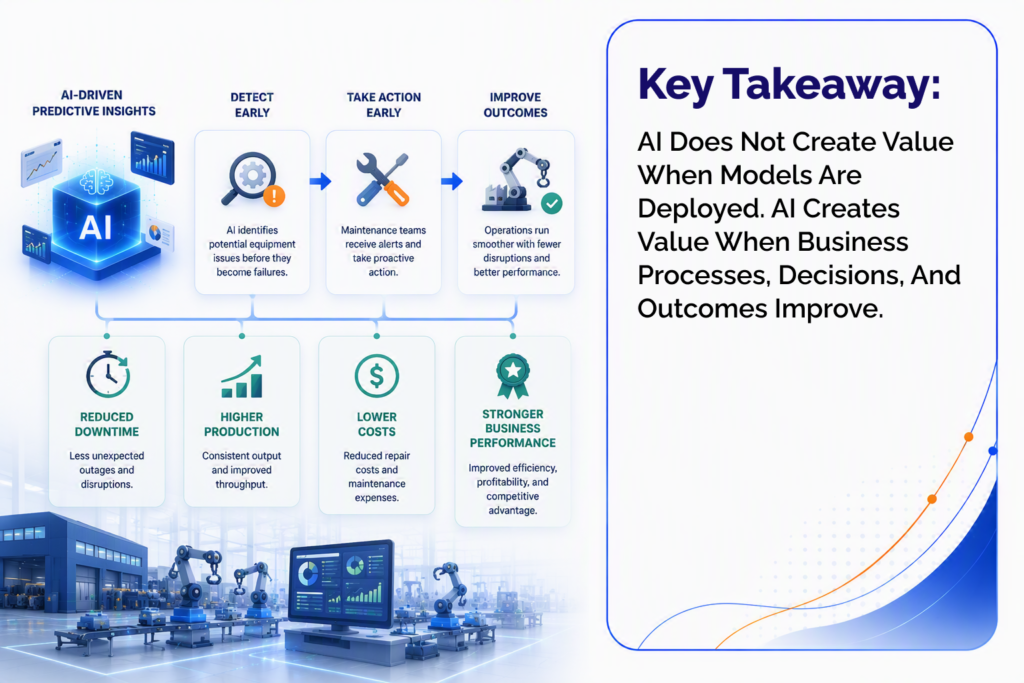
Example: A manufacturing company may use AI to predict equipment failures before they occur. The predictive model itself has little business value if maintenance teams continue operating exactly as they did before. The value emerges when maintenance schedules become more proactive, downtime decreases, production improves, and operating costs decline. The outcome comes from operational action rather than predictive capability alone.
The Organizations Creating Real Value Are Thinking Differently
The enterprises generating the strongest returns from AI tend to approach the challenge from a different perspective.
Rather than beginning with technology, they begin with business objectives.
Instead of asking, “Where can AI be applied?” they ask, “Where does the business need to improve?” They identify areas where customer experiences are suffering, productivity is constrained, decision-making is slow, or operational costs are increasing. Once the business objective is clear, AI becomes a tool for achieving that objective.
This seemingly simple shift often changes the trajectory of an AI initiative.
Organizations that start with technology frequently struggle to identify measurable value. Organizations that start with business outcomes have a clear target they are trying to achieve from the very beginning.
The most successful companies increasingly view AI as an operational capability rather than an isolated technology project. They embed intelligence into workflows, support employees with better information, and create systems that help teams make faster and more informed decisions.
Research indicates that organizations achieving stronger AI outcomes are focused not only on deploying technology but also on changing how work is performed across the enterprise. [mckinsey.com], [mckinsey.com]
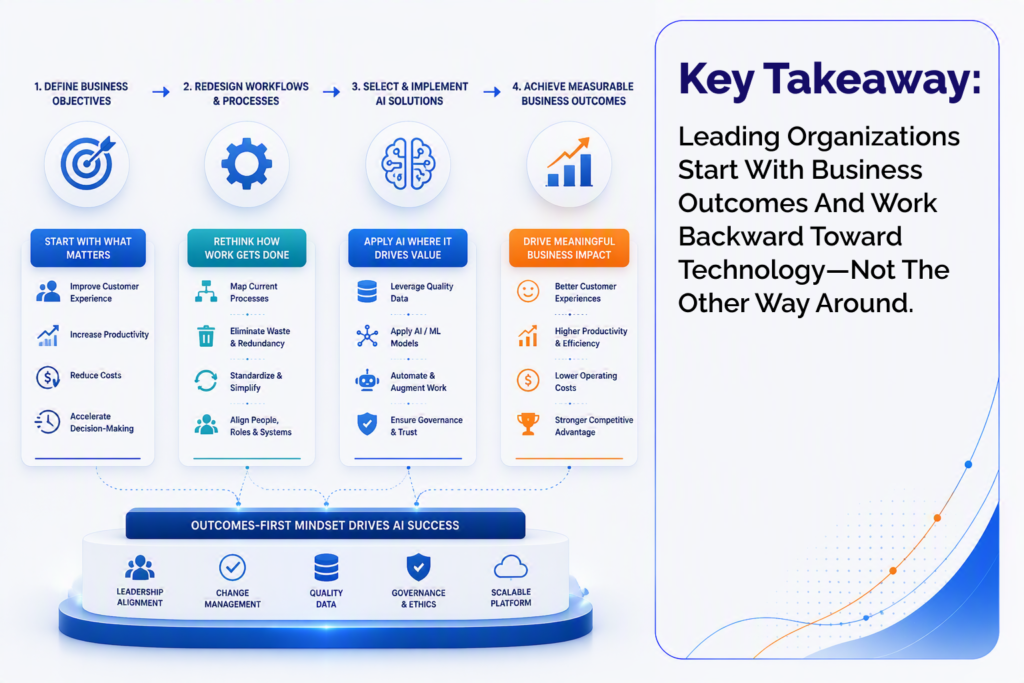
Example: A healthcare payer seeking to reduce claims processing time may define a target of reducing review cycles by 30 percent. AI is then introduced to automate document review, prioritize workloads, and streamline approvals. Because the initiative began with a business objective, success becomes measurable and aligned to organizational goals.[KB3]
Why Data, Governance, and Modernization Matter More Than Ever
As AI initiatives expand, organizations often discover that the technology itself is not the biggest barrier to success.
The bigger challenge is the foundation beneath it.
Many enterprises continue to struggle with fragmented data, disconnected systems, legacy infrastructure, and inconsistent governance frameworks. These challenges have existed for years, but AI often exposes them more clearly because intelligent systems depend heavily on the quality, accessibility, and context of enterprise data.
Forbes has highlighted the growing importance of unified data environments that bring together information across cloud, on-premises, and hybrid ecosystems. Without connected data, organizations struggle to provide AI systems with the context necessary to support reliable decision-making. [forbes.com], [forbes.com]
This is one reason modernization initiatives are becoming increasingly tied to AI strategies. Organizations are recognizing that modern platforms, unified data environments, and governance frameworks provide the foundation required to scale AI across the business.
AI does not operate in isolation. Its effectiveness depends on the systems, processes, and data that surround it.
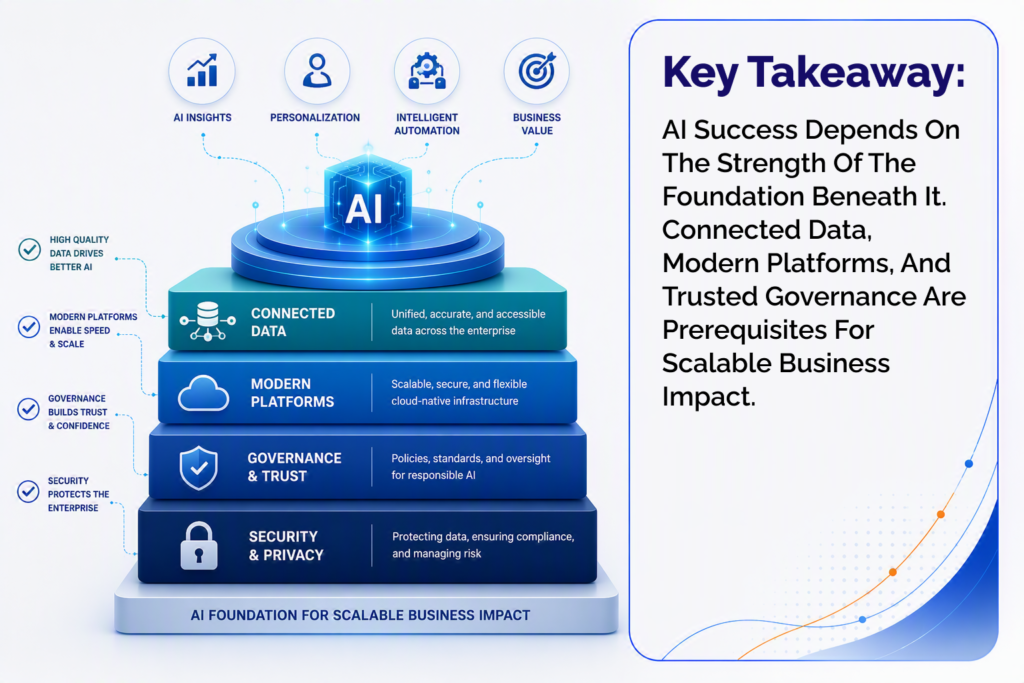
Example: A retail organization looking to personalize customer experiences may discover that customer information is spread across marketing platforms, loyalty systems, e-commerce platforms, and store operations. Once those data sources are connected and governed effectively, AI gains a much richer understanding of customer behavior, dramatically improving the relevance and effectiveness of recommendations.
The Next Phase of Enterprise AI Is About Accountability
As enterprise AI investments continue to grow, executive expectations are growing as well.
Boards are asking tougher questions. Investors want measurable returns. Business leaders want clearer connections between technology investments and operational performance.
As a result, organizations are becoming more disciplined about measurement.
Technical metrics still matter, but business metrics increasingly define success. Productivity improvements, revenue growth, operational efficiency, customer retention, cost reduction, and risk mitigation are becoming the benchmarks by which AI initiatives are evaluated.
This shift is healthy for the market because it encourages stronger alignment between business priorities and technology investments. It also helps organizations focus resources on initiatives that drive meaningful outcomes rather than simply generating activity.
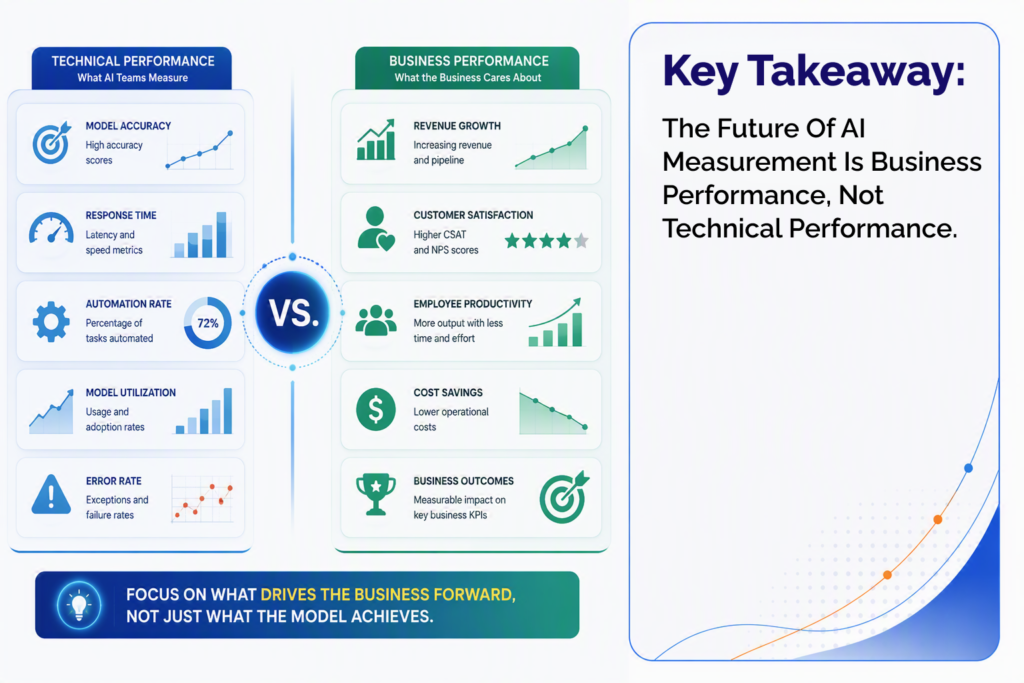
Example: Early in an AI program, leadership may focus on metrics such as model accuracy, response quality, or automation rates. As initiatives mature, attention shifts to outcomes such as increased profitability, faster service delivery, higher employee productivity, and improved customer satisfaction. These are the measurements that determine whether AI is creating lasting enterprise value.
The Opportunity Ahead
The organizations that lead the next phase of AI adoption will not necessarily be those with the largest budgets, the most advanced models, or the greatest number of pilots.
They will be the organizations that figure out how to embed intelligence into the fabric of their business.
The opportunity ahead is far greater than automation alone. It is about improving decisions, accelerating execution, enhancing customer experiences, and creating organizations that can adapt more quickly to change. It is about turning information into action and action into measurable business outcomes.
AI is increasingly becoming a business capability rather than a technology initiative. Organizations that embrace that shift will be positioned to unlock greater value from their investments and create sustainable competitive advantage.
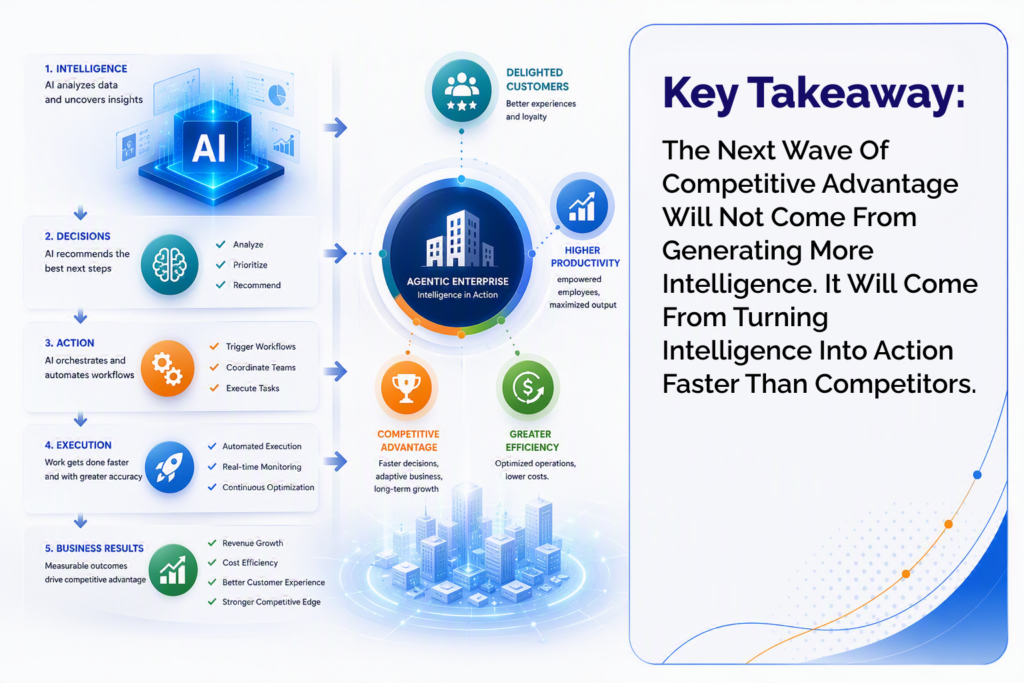
Example: Two organizations may have access to the same AI technologies. One uses AI primarily to generate insights and reports. The other embeds AI recommendations directly into operational workflows, allowing employees and systems to act immediately. Over time, the second organization gains an advantage because decisions happen faster, execution improves, and outcomes become more predictable. The technology may be identical, but the business impact is significantly different.
Sources
- McKinsey & Company, The State of AI: How Organizations Are Rewiring to Capture Value (2025). [mckinsey.com], [mckinsey.com]
- McKinsey & Company, The State of AI in 2025: Agents, Innovation, and Transformation (2025). [mckinsey.com]
- Forbes Technology Council, AI-Driven Data Clouds: Strategic Best Practices for Modern Enterprises (2025). [forbes.com]
- Forbes, Why AI-Driven Data Modernization Is Your Competitive Edge (2025). [forbes.com]