
The Future of AI Isn’t Insight, It’s Action: Why the Agentic Enterprise Is the Next Evolution of Business
For years, organizations have invested heavily in technologies designed to make them smarter. Business intelligence platforms gave leaders access to dashboards and reports. Analytics solutions uncovered patterns hidden within massive volumes of data. Machine learning improved forecasting and prediction. More recently, generative AI transformed how employees access information, create content, and interact with business systems.
Each of these innovations has delivered value. Together, they have fundamentally changed how organizations gather, analyze, and use information. Yet despite all these advances, many enterprises continue to face a familiar challenge. They know more about their business than ever before, but turning that knowledge into coordinated action often remains slow, fragmented, and highly dependent on manual processes.
This is where the concept of the Agentic Enterprise is beginning to gain momentum.
The idea is not simply that AI can provide better answers. It is that AI can actively participate in helping the business execute. Rather than functioning solely as a tool employees interact with, AI becomes a collaborator that helps coordinate activities, recommend actions, orchestrate workflows, and support decisions across the organization. The result is a fundamentally different operating model—one where intelligence is no longer confined to dashboards and reports but becomes embedded directly into how work gets done.
Recent research from McKinsey suggests the market is already moving in this direction. While AI adoption continues to grow rapidly, the organizations capturing the greatest value are increasingly focused on transforming workflows and operating models rather than simply deploying technology. McKinsey also notes growing experimentation with AI agents and agentic systems as companies look beyond individual use cases and toward enterprise-wide transformation (McKinsey). The next phase of AI, it seems, is not about generating more intelligence. It is about operationalizing it.
The Enterprise Has No Shortage of Intelligence
One of the great ironies of modern business is that most organizations have never been more informed, yet many still struggle to act quickly enough on what they know.
Every day, leaders receive performance metrics, customer insights, operational reports, financial forecasts, and market intelligence. Data flows continuously across the enterprise, providing visibility into nearly every aspect of business performance. The challenge is rarely a lack of information. More often, it is the difficulty of translating information into action.
A sales leader may know which accounts are showing strong buying signals but still depend on multiple teams and systems to coordinate outreach. A supply chain executive may identify an emerging disruption but require several meetings and approvals before adjustments can be made. Operations teams may recognize inefficiencies, yet improvements move slowly because information must travel across departments before decisions can occur.
This growing gap between insight and execution is one of the primary reasons the Agentic Enterprise is attracting attention. The organizations gaining advantage today are not necessarily those collecting more data. They are those creating mechanisms that allow intelligence to flow more directly into decision-making and action.
McKinsey’s research suggests that organizations creating the most value from AI are redesigning business processes and integrating AI into workflows rather than simply layering AI on top of existing systems (McKinsey). This reflects a broader shift away from AI as a tool and toward AI as a participant in business operations.
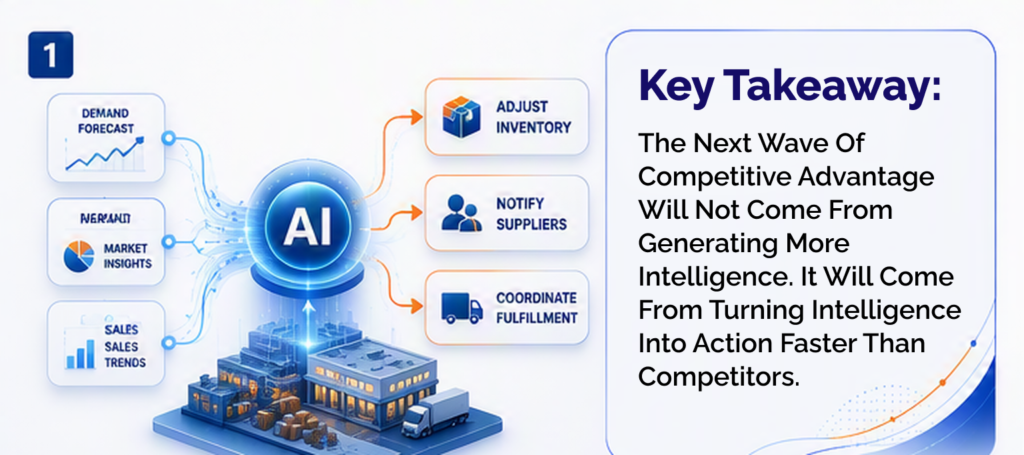
Enterprise Example: A retailer may identify rising demand for a product through forecasting and analytics. Traditionally, inventory planners, supply chain teams, logistics partners, and procurement leaders would need to coordinate responses manually. In an Agentic Enterprise, AI-driven systems can recommend inventory adjustments, trigger supplier communications, and coordinate fulfillment activities automatically, significantly reducing the lag between opportunity and execution.
From Automation to Autonomy
The Agentic Enterprise represents the next logical step in the evolution of business technology.
Organizations first digitized manual processes. Then they automated repetitive tasks. Today, AI is enabling something different: systems that can proactively monitor business conditions, identify opportunities, coordinate actions, and recommend next steps without requiring constant human intervention.
This evolution does not mean removing people from the equation. Instead, it means reducing the amount of time employees spend gathering information, switching between applications, coordinating activities, and managing routine workflows. AI agents can handle many of those responsibilities, allowing employees to focus on work that requires creativity, judgment, strategy, and relationship building.
This distinction is important because many discussions about AI focus too heavily on automation. Automation is often about completing a task. Agentic AI is about advancing an objective. Rather than simply executing instructions, intelligent agents can help determine what should happen next and support the broader workflow required to achieve an outcome.
McKinsey’s research increasingly points toward this evolution, noting that organizations are beginning to rethink how work happens rather than simply adding AI capabilities to existing processes (McKinsey). The companies realizing meaningful value from AI are often redesigning workflows entirely.
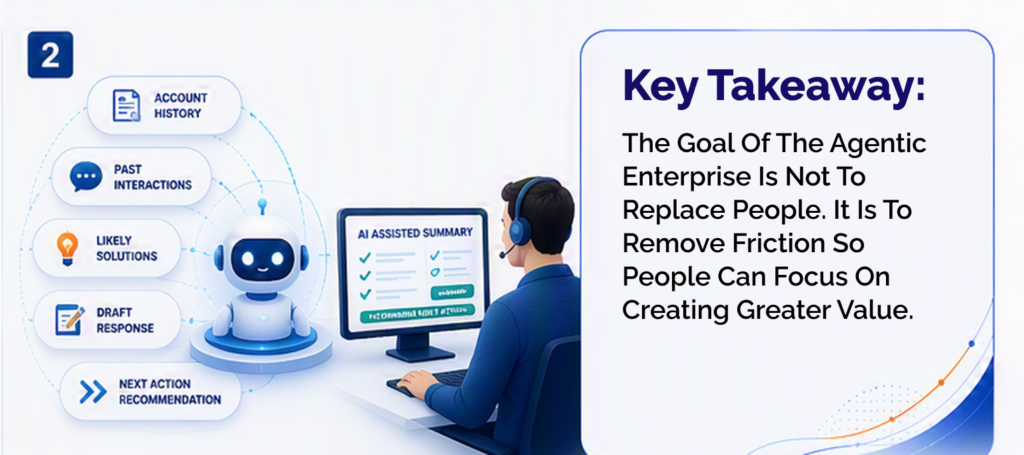
Enterprise Example: In a customer service environment, AI agents can gather account history, summarize interactions, identify likely solutions, draft responses, and recommend next actions before a representative even joins the conversation. The employee remains central to the customer relationship, but much of the administrative overhead disappears.
Why Trust and Governance Matter More Than Ever
As organizations move toward more autonomous operations, trust becomes increasingly important.
Leaders may be comfortable allowing AI to generate content, provide recommendations, or summarize information. Giving AI a more active role in business execution introduces a different level of responsibility. Questions naturally arise around accountability, transparency, compliance, data security, and risk management.
The organizations moving most successfully toward agentic operating models recognize that trust and governance are not barriers to innovation. They are prerequisites for scale.
Without governance, every new AI initiative creates a new risk discussion. Leadership teams become hesitant to expand AI into critical processes. Employees become reluctant to rely on recommendations. Customers question how decisions are being made. Progress slows because confidence remains limited.
Research from McKinsey found that organizations with stronger AI governance structures and executive oversight tend to report better business outcomes from AI initiatives (McKinsey). Rather than slowing AI adoption, governance often creates the confidence needed to accelerate it.
The future of enterprise AI is unlikely to be defined by unrestricted autonomy. Instead, it will be characterized by controlled autonomy, where intelligent systems handle routine decision-making while human oversight remains present for higher-risk situations.
Enterprise Example: A financial institution may use AI agents to monitor transactions, identify unusual behavior, and recommend fraud responses. Routine cases can be handled automatically, while complex or high-risk situations are escalated to human analysts. The result is faster response times without sacrificing transparency or accountability.
The Operating Model of the Future Is Becoming More Intelligent
Perhaps the most significant implication of the Agentic Enterprise is that it changes how work flows through an organization.
Traditional enterprises are built around handoffs. Information is gathered, analyzed, reviewed, approved, and then acted upon. Every transition introduces delays and opportunities for inefficiency. Even when organizations have access to the right information, execution often slows because systems and teams are not connected effectively.
Agentic systems help reduce this friction. They continuously monitor business conditions, surface opportunities, coordinate actions, and support decisions across multiple functions. Rather than requiring employees to act as intermediaries between systems, intelligent agents help connect information, decisions, and execution.
This capability becomes even more powerful when combined with connected enterprise data. Forbes has highlighted the growing importance of unified data environments that connect information across cloud, on-premises, and hybrid systems, creating the context required for effective AI decision-making (Forbes). Without that context, even the most advanced AI systems struggle to generate meaningful business value.
The Agentic Enterprise therefore represents more than a technology initiative. It represents a new operating model designed to make organizations more adaptive, responsive, and efficient.
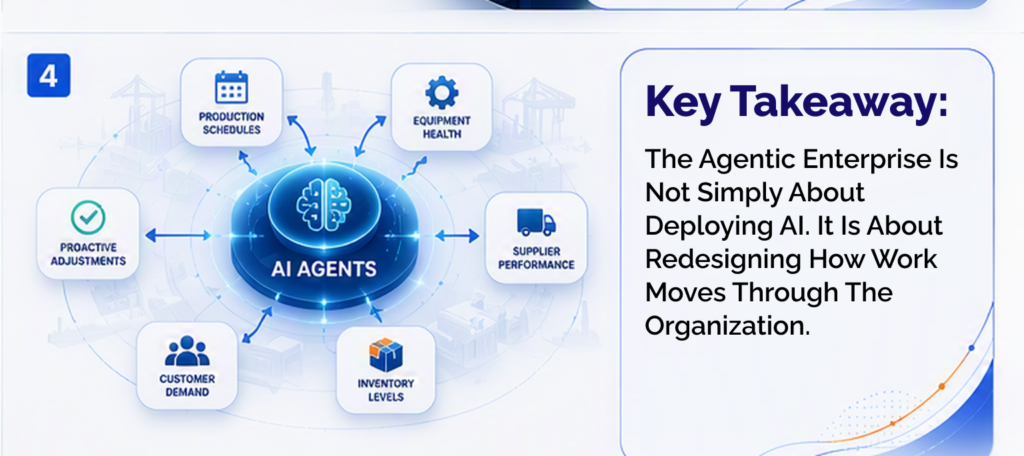
Enterprise Example: A manufacturing company may use intelligent systems to monitor production schedules, equipment health, supplier performance, inventory levels, and customer demand simultaneously. AI agents can recommend adjustments across multiple operational areas before disruptions occur, helping the organization respond proactively rather than reactively.
The Organizations That Start Today Will Move Faster Tomorrow
Like every major technology transformation, the Agentic Enterprise will not appear overnight.
Most organizations are still building the foundations required to make this future possible. They are modernizing data platforms, strengthening governance frameworks, connecting systems, and improving access to trusted information. These investments may seem disconnected from agentic AI, but they are actually essential enablers.
Organizations cannot become agentic if data remains fragmented. They cannot scale autonomous workflows without governance. They cannot embed AI into operations if core systems are disconnected.
Forbes recently noted that modernization and AI readiness are becoming increasingly intertwined as organizations look for ways to transform raw information into real-time operational intelligence (Forbes). The implication is clear: long-term success with agentic AI depends heavily on the investments organizations make today.
History has consistently shown that competitive advantage comes not from technology access alone but from readiness. Organizations that prepare their foundations early are often the first to realize meaningful value when new capabilities emerge.
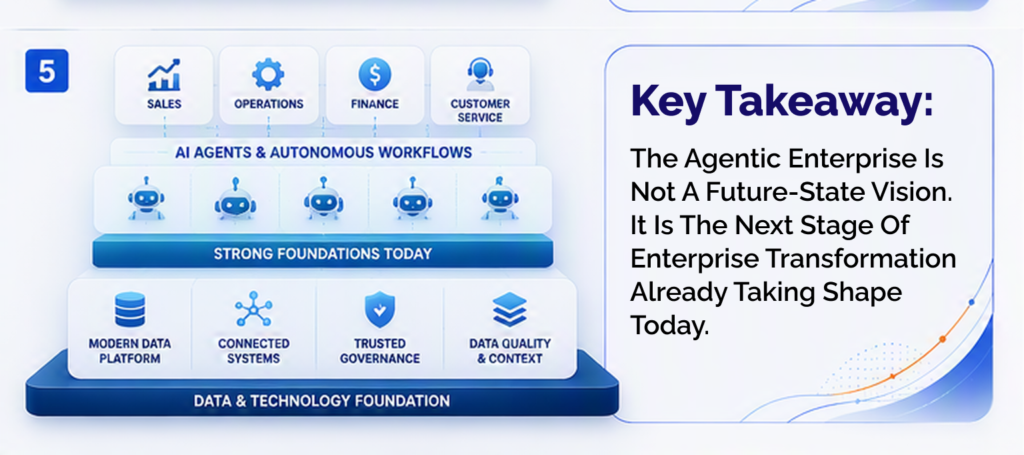
Enterprise Example: An organization that has already modernized its data platform and established trusted governance practices will be far better positioned to deploy AI agents across sales, operations, finance, and customer service than an organization still struggling with disconnected systems and siloed information.
The Opportunity Ahead
Every major technology era eventually reaches a point where the focus shifts from the technology itself to the outcomes it enables.
AI appears to be approaching that moment.
For years, organizations concentrated on generating intelligence. The next chapter will focus on action. The enterprises that thrive will not simply produce better insights than their competitors. They will convert those insights into decisions and decisions into execution faster and more consistently than others.
That is ultimately what the Agentic Enterprise represents.
Not a world where machines replace people, but a world where intelligence becomes an active participant in how the business operates.
The organizations that win in this environment will not necessarily have access to better AI than everyone else. They will have built operating models that allow intelligence, people, and processes to work together more effectively. They will be more adaptive, more responsive, and better equipped to navigate change.
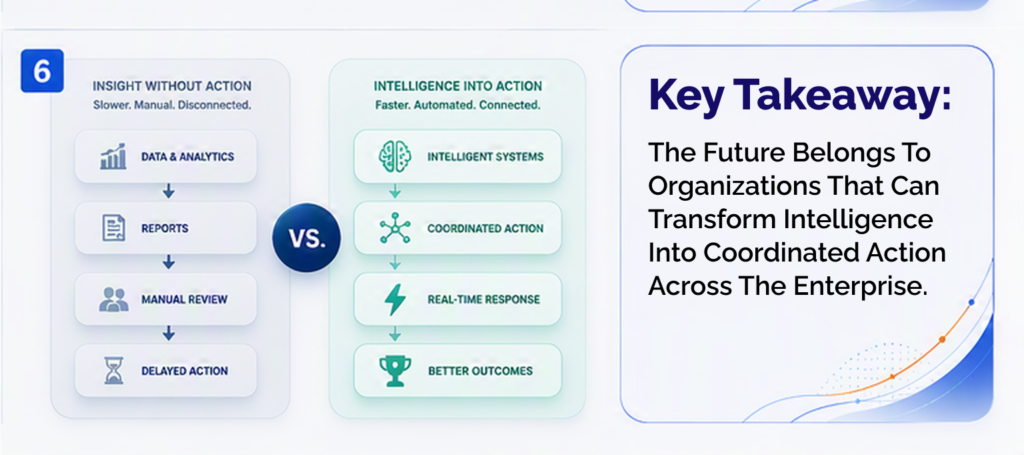
Enterprise Example: Two organizations may have access to the same AI technologies. One uses them primarily to generate reports and recommendations. The other embeds intelligence directly into business workflows, allowing systems and employees to respond immediately. Over time, the second organization becomes more agile, more efficient, and more competitive—not because it has better technology, but because it has built a better way of operating.