
The Biggest AI Challenge Isn’t AI Why data, modernization, and connectivity have become the real competitive advantage.
Over the past few years, artificial intelligence has dominated conversations in boardrooms, executive strategy sessions, and technology roadmaps. Organizations have invested heavily in AI platforms, generative AI tools, machine learning models, and automation capabilities, all with the goal of creating smarter operations and unlocking new business value.
Yet as AI initiatives move beyond experimentation, many organizations are encountering an unexpected reality.
The challenge isn’t the AI. The challenge is everything surrounding it.
Across industries, business and technology leaders are discovering that achieving meaningful outcomes from AI often has less to do with the sophistication of the model and more to do with the condition of the environment in which it operates. Data is scattered across disconnected systems. Information is trapped in silos. Legacy platforms limit agility. Governance models vary across departments. Processes have evolved over decades but were never designed for an AI-enabled enterprise.
The result is a growing recognition that AI success depends on something much more fundamental than technology adoption.
It depends on the foundation beneath it.
Recent research from McKinsey reinforces this idea. While AI adoption has become widespread, many organizations are still working to move beyond experimentation and realize enterprise-scale value. The companies generating stronger outcomes are increasingly focused on organizational readiness, operational integration, workflow redesign, and the structures that allow intelligence to scale across the business. [mckinsey.com], [mckinsey.com]
In many ways, the conversation around AI is beginning to resemble the early days of cloud computing. The technology itself may be powerful, but its value is ultimately determined by the infrastructure, processes, and operating model that support it.
For enterprise leaders, this represents an important shift in perspective. Instead of asking, “What can AI do?” the more relevant question may be, “Is the organization prepared to support AI at scale?”
AI Is Exposing Challenges That Already Existed
One of the most interesting aspects of the current AI wave is that many of the barriers organizations encounter are not actually AI problems.
They are enterprise problems that AI happens to reveal.
For years, organizations have operated with fragmented technology environments. Customer information often lives across CRM systems, ERP platforms, marketing tools, operational databases, and countless spreadsheets. Business units frequently maintain different versions of the same information. Data definitions vary. Processes are inconsistent. Reporting often requires significant manual effort.
Most organizations learned to work around these challenges. AI, however, is forcing organizations to confront them directly.
When an AI system attempts to generate recommendations, automate decisions, or provide business insights, it depends on having access to reliable and complete information. If that information is fragmented, the quality of the output is inevitably affected.
This is why many organizations discover that AI projects become increasingly difficult as they attempt to scale. What may work successfully within a single department often becomes more challenging when extended across the enterprise.
The issue is not that the AI is broken. The issue is that the organization lacks a connected foundation.
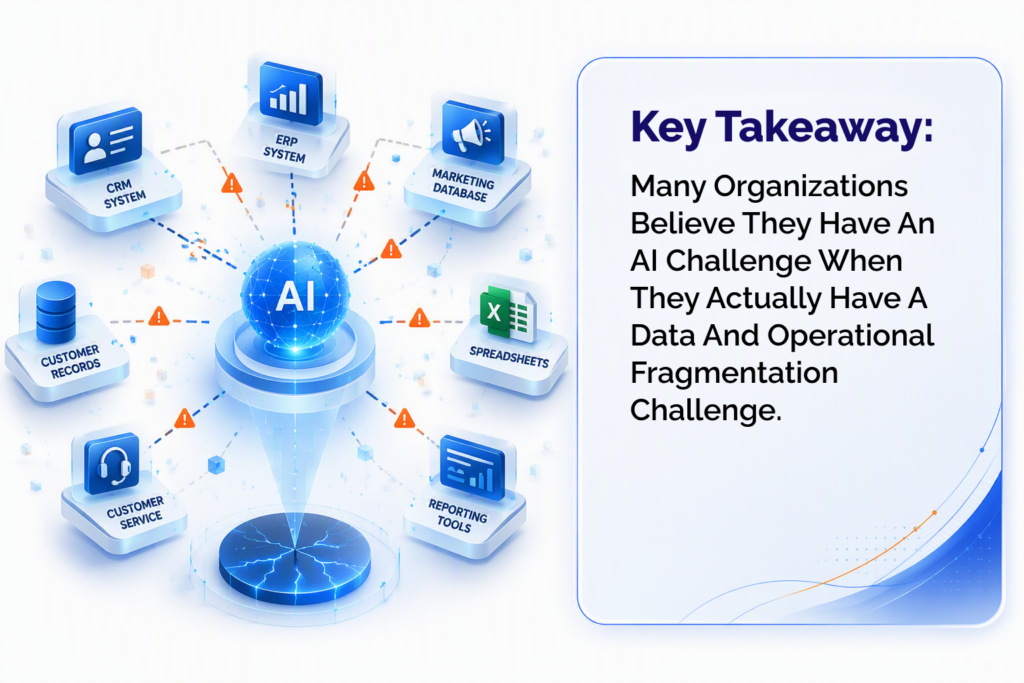
Example: A financial services organization may want to use AI to create a unified view of a customer relationship. However, customer data exists across lending systems, wealth management platforms, customer service applications, and marketing databases. The AI may function exactly as designed, but without a connected view of the customer, its recommendations remain incomplete. The limitation is not the AI itself—it is the fragmented environment surrounding it.
Why Connected Data Has Become the Starting Point for AI Success
Every executive understands the value of information. What has changed is the growing realization that information only becomes powerful when it can be connected, contextualized, and operationalized.
Many organizations have spent years collecting enormous amounts of data. The challenge is that the data often exists in isolation. Individual systems may provide valuable insights into customers, products, operations, employees, or finances, but they rarely provide a complete picture of the business.
This is where the concept of connected enterprise data becomes so important.
According to research highlighted by Forbes, modern enterprises are increasingly focusing on unified data environments that integrate structured, semi-structured, and unstructured information across cloud, on-premises, and hybrid systems. The goal is not simply to centralize data. The goal is to create context that enables intelligent decision-making. [forbes.com], [forbes.com]
Context is what transforms data into intelligence.
When AI systems can understand relationships between customers, products, transactions, supply chains, operations, and business outcomes, they become significantly more valuable. Recommendations improve. Insights become more actionable. Decisions happen faster.
Without that context, organizations often find themselves generating more information without generating better outcomes.
The difference between those two scenarios is substantial.
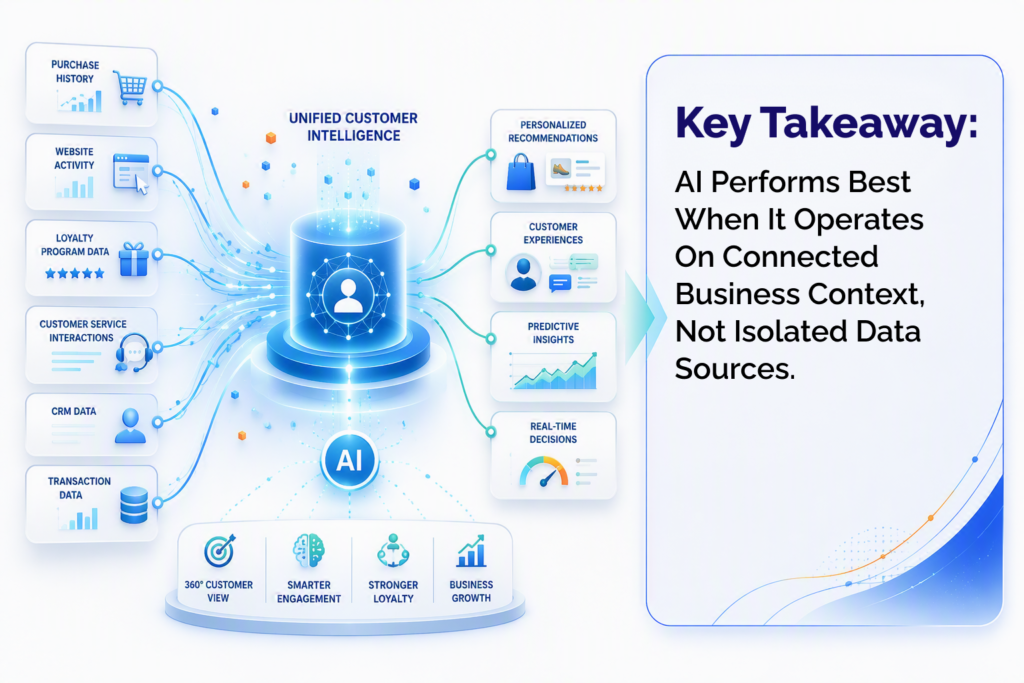
Example: A retailer looking to improve customer engagement may have access to purchase history, website activity, loyalty program data, and customer service interactions. Individually, each source provides useful information. Connected together, they provide a comprehensive understanding of customer behavior that allows AI to deliver highly personalized experiences and recommendations.
Modernization Is No Longer an IT Initiative
For many years, modernization programs were often viewed as technology upgrades. They were important, but they were frequently perceived as infrastructure projects rather than business transformation initiatives.
That perception is changing rapidly.
As organizations pursue AI initiatives, many are discovering that modernization is no longer separate from AI strategy—it is AI strategy.
Legacy systems often create obstacles that slow AI adoption. Data accessibility becomes limited. Integrations become more complex. Governance becomes harder to manage. Innovation cycles lengthen. As a result, organizations may possess powerful AI capabilities but lack the environment necessary to use them effectively.
Forbes recently noted that AI-driven data modernization is increasingly becoming a competitive differentiator because organizations that modernize their environments can make faster decisions, improve agility, and generate more value from their information assets. [forbes.com], [forbes.com]
What makes this particularly interesting is that modernization is no longer just about reducing technical debt.
It is about creating business readiness.
Organizations that modernize successfully position themselves to adopt new technologies faster, respond to market changes more effectively, and scale AI initiatives with greater confidence.
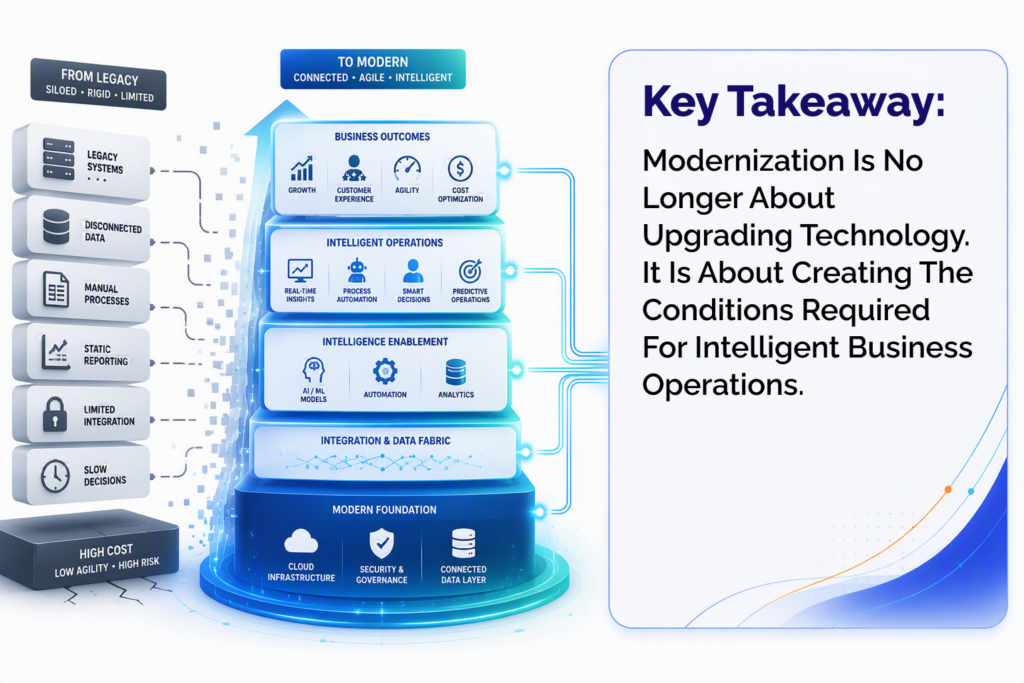
Example: A manufacturing company that migrates from legacy reporting environments to a modern data platform may initially justify the effort through efficiency gains. However, the larger value often emerges later when AI models can access real-time production data, predict maintenance needs, optimize inventory, and support operational decision-making at scale.
The Future Belongs to Organizations That Build Intelligent Foundations
As AI adoption accelerates, competitive advantage is likely to shift away from access to technology.
AI models are becoming increasingly accessible. Generative AI platforms continue to proliferate. New capabilities are being introduced at an extraordinary pace.
Over time, access to AI will become less of a differentiator. The true differentiator will be how effectively organizations integrate AI into the fabric of their business.
That requires a strong foundation.
It requires connected data. It requires modern platforms. It requires governance frameworks that support trust and accountability. It requires processes that enable intelligent action. Most importantly, it requires leadership teams willing to view AI as part of a broader transformation journey rather than as a stand-alone technology initiative.
Organizations that build these foundations today will be positioned to capture greater value from every future advance in AI.
Organizations that do not may continue to experiment while struggling to scale.
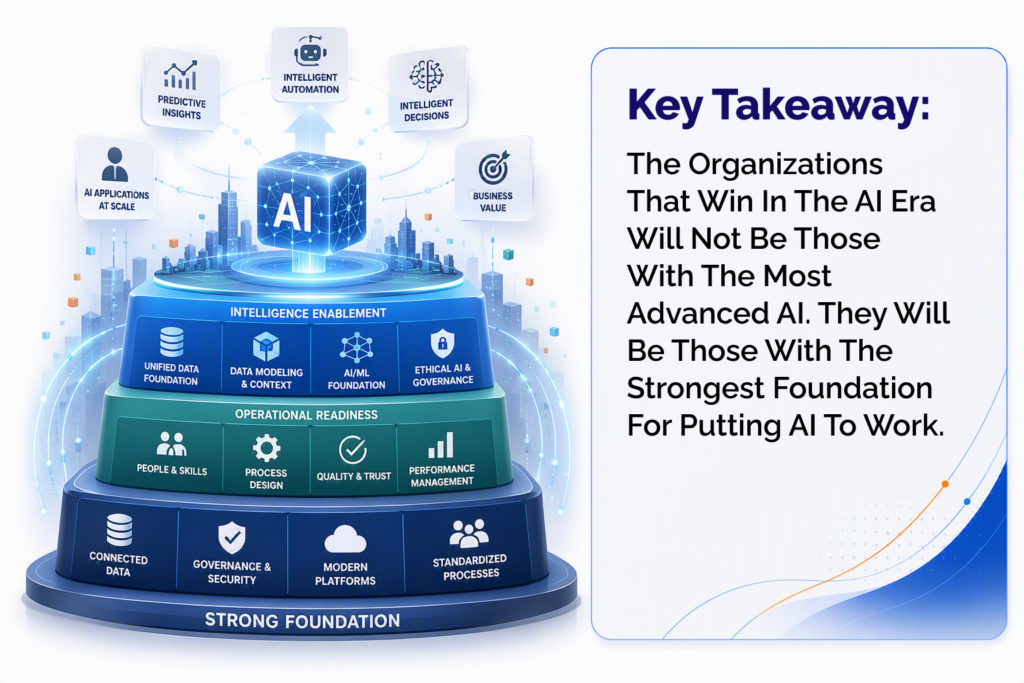
Example: Two organizations may adopt the same AI platform. One operates with fragmented systems, siloed data, and inconsistent governance. The other has invested in modernization, connected enterprise data, and standardized processes. While both have access to the same technology, the second organization is far more likely to realize business value because the foundation already exists to support intelligent decision-making at scale.
The Opportunity Ahead
For years, conversations about digital transformation focused on digitizing processes, migrating workloads, and improving operational efficiency. The rise of enterprise AI has raised the stakes considerably.
Today, organizations are no longer simply trying to become digital. They are attempting to become intelligent.
That transition requires a different way of thinking. Success is no longer determined by the technologies that are purchased or the models that are deployed. Success is determined by whether the organization can create an environment where intelligence flows freely across the business, enabling employees, customers, and systems to make better decisions.
AI may be the catalyst driving this transformation, but the foundation remains the determining factor.
Organizations that invest in connected data, modernization, governance, and operational readiness will be positioned to unlock greater value from AI for years to come.
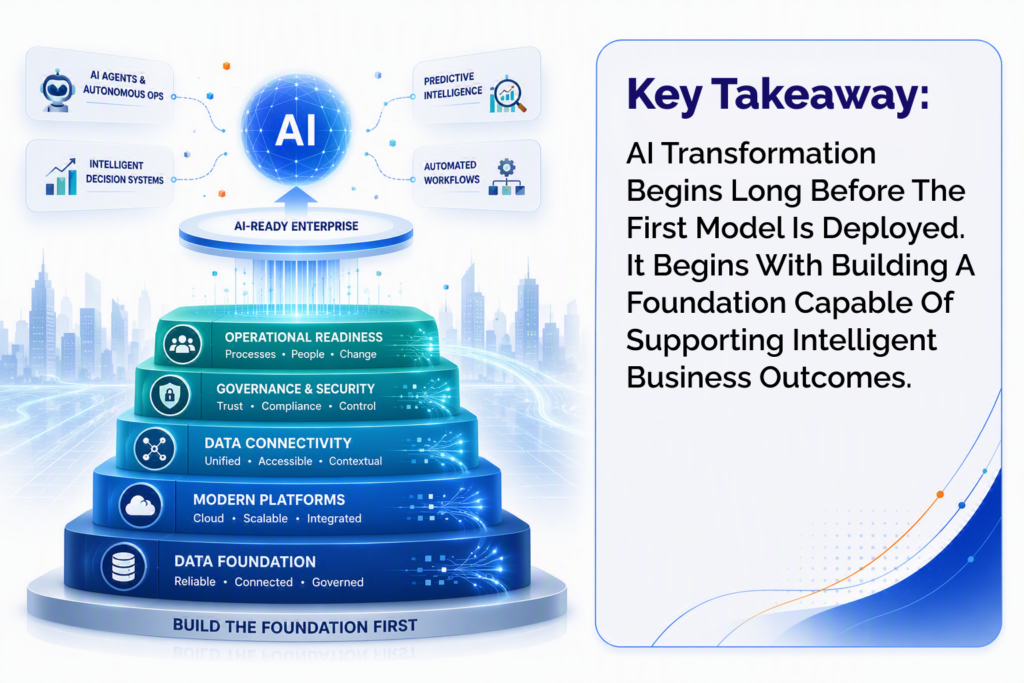
Example: Organizations that prioritize modernization, data connectivity, and governance today will be better positioned to adopt future innovations—from agentic AI and autonomous operations to intelligent decision systems—without having to rebuild their foundations later.
Sources
- McKinsey & Company, The State of AI: How Organizations Are Rewiring to Capture Value (2025). [mckinsey.com], [mckinsey.com]
- McKinsey & Company, The State of AI in 2025: Agents, Innovation, and Transformation (2025). [mckinsey.com]
- Forbes Technology Council, AI-Driven Data Clouds: Strategic Best Practices for Modern Enterprises (2025). [forbes.com]
- Forbes, Why AI-Driven Data Modernization Is Your Competitive Edge (2025). [forbes.com]