
DARTS™:
Automated Code Generation
Why Traditional Software Delivery Holds You Back
For most enterprises, software development is slow, costly, and unpredictable. Manual builds, disconnected teams, and delayed governance create friction that drives up capital spend and stalls innovation. By the time code is written, tested, and approved, business needs have already shifted. Common challenges include:

Lengthy, resource-heavy development cycles

Late-stage compliance checks that cause rework

Inconsistent quality and delivery timelines

Difficulty maintaining alignment between business intent and technical execution
AI-Powered Code Generation
Automated code generation improves delivery speed and accuracy when it reduces interpretation gaps and replaces manual rework with repeatable, validated AI-powered outputs. DARTS™ does this by connecting AI, automation, and governance in a unified Spec‑to‑Code model—so specifications move directly into working, validated, compliant software.
Engineering Software Delivery with Intelligent Agents
Enterprise software delivery breaks down when intent is lost between specifications, code, and governance. DARTS™ reflects CEI’s applied approach to agentic AI—designed to transform structured specifications directly into working, validated, and compliant software. Built and governed by CEI, DARTS™ demonstrates how intelligent agents can be orchestrated across the delivery lifecycle to accelerate engineering speed while maintaining enterprise standards, traceability, and control.
How DARTS™ Accelerates Enterprise Engineering
Moving from specifications to working software becomes practical at scale when the delivery lifecycle is designed for structured intent, automated execution, and continuous improvement—versus one‑off execution. DARTS™ is powered by CEI’s Spec‑to‑Code framework, an agentic development model that orchestrates intelligent agents across each phase of delivery.
Step 1: Specification Modeling
Enterprises capture business requirements in a structured, machine‑readable format so business intent stays intact and interpretation errors drop early—before they become expensive downstream rework.
Step 5: Scale & Reuse
Development time and cost drop when reusable patterns, templates, and assets compound across projects—so teams repeat proven delivery rather than restarting from scratch.
Step 4: Continuous Feedback & Learning
Quality and precision improve over time when the system learns from each iteration—using feedback loops to refine outputs and raise delivery consistency from build to build.
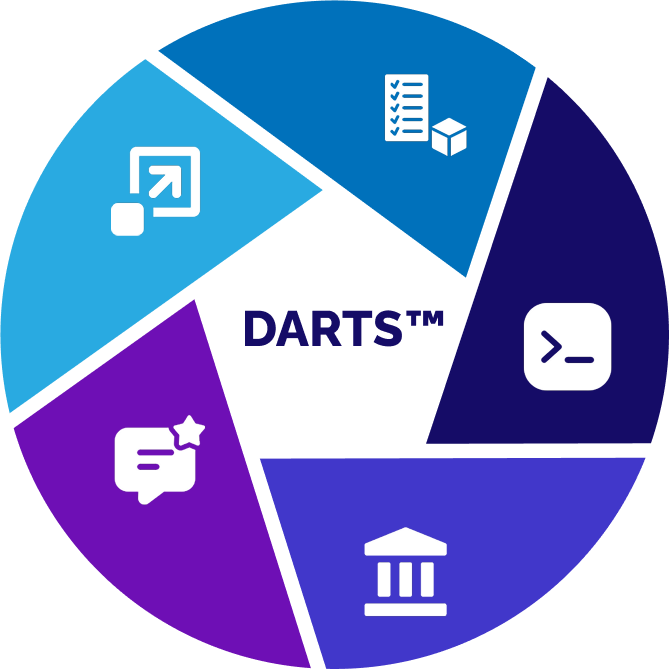
Step 2: Spec-to-Code Execution
The transition from specifications to working software is automated by generating functional code, documentation, and test cases directly from those specifications—accelerating delivery with precision rather than shortcuts.
Step 3: Governance & Validation
Governance and compliance are enforced automatically during software delivery through built‑in validation that checks architectural, security, and compliance standards as work progresses—not after the fact.
AI Agents for Speed & Compliance
AI agents improve software delivery speed while ensuring compliance when specialized roles are embedded in the workflow—design, code generation, validation, and governance—so every build stays fast, compliant, and aligned to enterprise goals. DARTS™ applies this agent‑driven approach to keep delivery moving without letting standards drift.

The Measurable Value of Spec-to-Code Intelligence
Organizations leveraging DARTS™ experience transformational gains in software delivery speed, efficiency, and predictability:
30–50%
Faster delivery cycles
via embedded validation
and compliance
25%
Improvement in software quality
through automated code generation
and validation
35–40%
Reduction in engineering effort
with Spec-to Code orchestration

Consistent governance and
predictability across large-scale
engineering programs

Reduce capital costs and deliver
high-quality software with
confidence
Accelerate time-to-
market for new products
and features